You eat three times a day.
Sometimes more.
Most people choose the second option without even realizing it.
They eat too fast. They eat too much. They eat the wrong things at the wrong times in the wrong positions while staring at screens and barely tasting a single bite. Then they wonder why they feel sluggish, bloated, and perpetually tired.
The Prophet Muhammad ﷺ ate differently.
His approach to food wasn't a diet. It wasn't a wellness trend. It wasn't a system invented by a nutritionist or sold by a health guru.
It was a complete philosophy of eating—just one essential piece of a complete Prophetic lifestyle—that balanced gratitude, discipline, community, and physical well-being

And it works.
Fourteen hundred years later, it works better than anything modern nutritional science has come up with.
The Foundation
Before getting into the specific practices, you need to understand the Prophet's ﷺ foundational attitude toward food.
He never ate to excess. He never obsessed over food. He never used eating as a way to cope with emotions or fill a void.
He ate to live—not lived to eat.
He once said:
"The son of Adam does not fill any vessel worse than his stomach. It is sufficient for the son of Adam to eat a few mouthfuls to keep him alive. But if he must do that, then one third for his food, one third for his drink, and one third for his air." (Ibn Majah)
That one hadith contains more nutritional wisdom than most diet books combined.
Your stomach is not a vessel to be filled.
It's an organ to be respected. And when you treat it with respect—when you eat with intention and moderation—everything changes. Your energy improves. Your mind clears and even your productivity increases.
Because an overfull stomach produces a heavy body, a clouded mind, and a lazy soul.
And a lazy soul doesn't pray with focus, doesn't read Quran with understanding, and doesn't serve people with energy.
The way you eat affects everything else you do.
And once you understand that, you'll never look at a meal the same way again.
Before You Eat: Intention and Bismillah
The Prophet ﷺ taught that every meaningful act begins with intention and the name of Allah. Eating is no different.
Before taking a single bite, he would say:
بِسْمِ اللهِ
"In the name of Allah."
And if he forgot at the beginning, he would say when he remembered:
بِسْمِ اللهِ فِي أَوَّلِهِ وَآخِرِهِ
"In the name of Allah at its beginning and its end." (Abu Dawud)
This simple act does something profound. It transforms eating from a mechanical, mindless act into a conscious, intentional one. When you say "Bismillah" before eating, you're pausing.
You're acknowledging that this food is a blessing from Allah, not something you're entitled to. You're making a choice to eat with awareness.
And the Prophet ﷺ said that when you say "Bismillah" before eating, Shaytan cannot share your meal. When you forget, Shaytan joins you and eats with you.
The Intention Behind the Meal
Beyond the words, the Prophet ﷺ also taught that your intention while eating matters.
If you eat with the intention of nourishing your body so you can worship Allah, serve others, and fulfill your responsibilities—that eating becomes worship.
You earn reward for every bite.
If you eat mindlessly, for entertainment, or out of boredom—it's just consumption. No reward. Just calories.
How He Sat
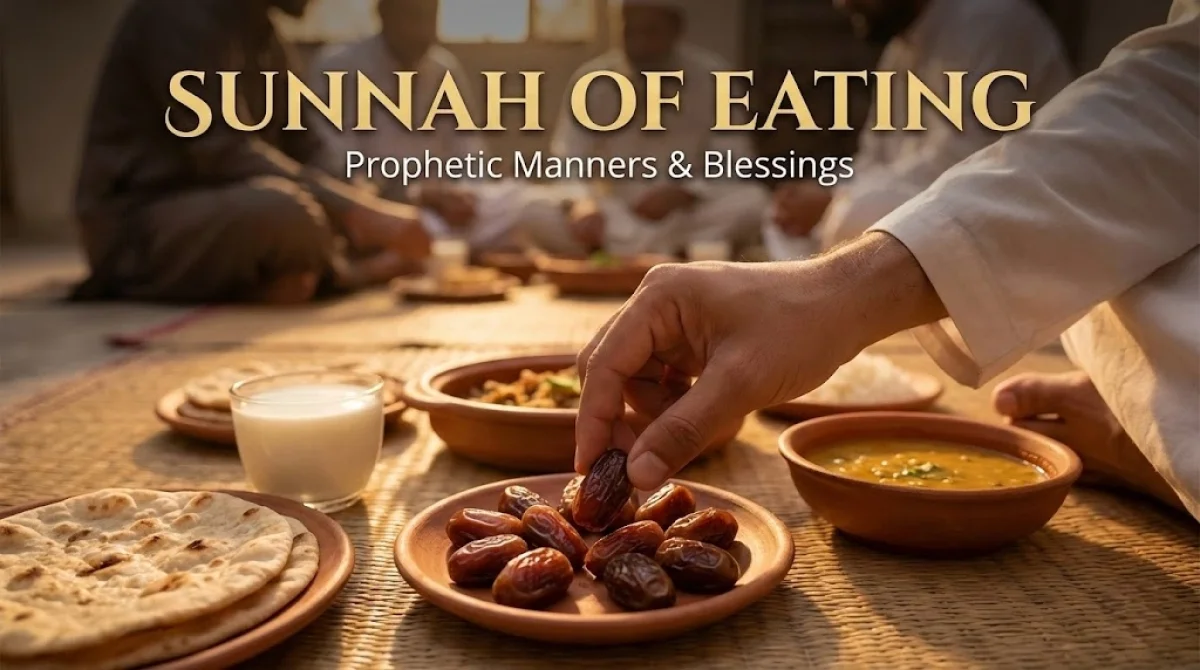
The Prophet ﷺ sat in one of two ways while eating: either with both knees on the ground, or with one knee raised and the other on the ground.
What he never did was recline.
He specifically said: "I do not eat while reclining." (Sahih al-Bukhari)
In Arabic culture, reclining while eating was a sign of arrogance and self-indulgence. The Prophet ﷺ rejected that posture because it communicated an attitude of entitlement—as if you're a king being served.
But there's also a physical reason. Eating while sitting upright on the floor engages your core, keeps your digestive tract in proper alignment, and naturally limits how much you can eat before feeling full.
Eating while reclined—or while sitting in a plush armchair or lying on a couch—allows you to eat far more than your body needs, because the food isn't pressing down naturally.
It's no coincidence that the rise of eating while reclining on couches in front of televisions has coincided with an epidemic of overeating and obesity.
The Prophet's ﷺ posture wasn't just about manners.
It was about health.
How He Ate: Three Fingers and Mindful Bites
The Prophet ﷺ ate with three fingers of his right hand. Not a spoon. Not a fork. Three fingers of the right hand.
Why does this matter?
When you eat with a spoon or fork, you can load up a large amount of food and shovel it in quickly, barely chewing, barely tasting. You finish the plate before your brain even registers that you've eaten.
When you eat with three fingers, you naturally take smaller bites.
You eat more slowly. You chew more thoroughly.
And because eating slowly gives your brain time to receive the "I'm full" signal from your stomach (which takes about 20 minutes), you stop eating before you've overeaten.
The Prophet ﷺ would also lick his fingers after eating, and lick the plate clean. He encouraged not wasting any food.
He would say: "You do not know in which part of your food the blessing is." (Sahih Muslim)
Modern food culture treats leftovers like garbage. We scrape plates into the trash without a second thought. The Prophet ﷺ treated every morsel as a blessing not to be wasted.
He also ate with his right hand and forbade eating with the left, saying that Shaytan eats with his left hand.
Beyond the symbolic meaning, there's a practical one: establishing a consistent habit around eating prevents mindless, automatic consumption.
How Much He Ate: The One-Third Rule
This is the most revolutionary—and most ignored—principle in the Prophet's ﷺ approach to eating.
One third for food. One third for water. One third for air.
Let's be very clear about what this means. He wasn't saying eat a third of your plate.
He was saying that your stomach should never be more than two-thirds full—with one third of that being liquid and the remaining third being empty space for air and proper digestion.
In practical terms, this means stopping before you feel full. Because by the time you feel full, you've already eaten too much. The fullness signal is delayed. If you eat until you "feel" full, you've overeaten.
The Prophet ﷺ would stop eating when he still had a little appetite left. When there was still room.
This practice—called "hara hachi bu" in Japanese culture, meaning eat until you're 80% full—has been studied extensively in the longest-lived populations in the world. The people in Okinawa, Japan, who practice this principle, consistently live longer and healthier lives than almost anyone else on earth.
The Prophet ﷺ practiced this 1,400 years before Japanese longevity researchers identified it.
And it's not just about longevity.
An overfull stomach leads to sluggishness, brain fog, and lethargy.
When you've eaten too much, you can't focus. You can't pray properly. You can't think clearly.
You just want to sleep—but even that sleep won't be the restorative prophetic sleep routine your body actually needs.
This is why scholars have observed that the corruption of worship often begins with the corruption of eating.
When you overeat, you lose the energy and focus to worship.
And Shaytan knows this.
His strategy has always been to encourage excess in eating because it leads to excess in every other sin.
What He Ate: Simple, Whole, and Blessed
The Prophet's ﷺ diet was remarkably simple by modern standards.
He ate dates—one of the most nutritionally dense foods on earth, rich in natural sugars, fiber, potassium, and antioxidants.
He ate bread made from barley—whole grain, unprocessed, full of fiber and slow-burning energy.
He drank milk—fresh, natural, rich in protein and calcium.
He ate honey, which he described as a cure for every disease except death. Modern medicine has confirmed honey's antibacterial, anti-inflammatory, and wound-healing properties.
He ate olive oil, calling it a blessed oil.
Olive oil is now recognized as the cornerstone of the Mediterranean diet—one of the healthiest eating patterns ever studied.
He occasionally ate meat—lamb, chicken, game—but not in excess.
Meat was a blessing, not a daily staple.
He loved dates and water for breaking his fast. Before prayer. Simple, quick to digest, immediate energy without the heaviness of a full meal.
Notice what's absent from his diet: processed foods, excess sugar, refined grains, artificial additives.
Everything he ate was whole, natural, and unprocessed.
What He Never Did
Just as important as what the Prophet ﷺ ate is what he avoided.
He never ate while standing.
He said it's better to vomit than to drink while standing. Modern gastroenterologists confirm that eating or drinking while standing increases the speed at which food enters the stomach, reduces proper digestion, and can cause acid reflux.
He never criticized food.
If he liked something, he ate it. If he didn't like something, he left it—but he never said a negative word about it.
He once entered the house and saw some lizard being cooked. He neither ate it nor forbade others from eating it. When asked, he said it wasn't from his people's culture, but he didn't prevent it.
This principle of never criticizing food teaches gratitude.
It's easy to complain about food when you have plenty of it. But the Prophet ﷺ lived through times of hunger. He understood that any food on the table is a blessing.
He never ate from the center of a dish.
He taught eating from the sides—from what's in front of you—not reaching into the middle where the blessing descends.
He never ate hot food.
He would wait for his food to cool before eating.
The Prophet ﷺ said: "Do not eat hot food until it has cooled down." Modern research confirms that consistently eating very hot food damages the lining of the esophagus and stomach.
Eating Together: Barakah of Shared Meals
One of the most overlooked aspects of the Prophet's ﷺ eating habits is the communal dimension.
He loved eating with others.
He said: "Eat together and do not eat separately, for the blessing is in being together." (Ibn Majah)
Modern research on loneliness and health has found that people who eat alone are more likely to be obese, depressed, and unhealthy than those who eat with others.
The Prophet ﷺ would invite people to eat with him.
He would make his guests feel honored. He would encourage them to eat and would often serve them himself.
He also taught feeding others as one of the most beloved acts to Allah.
In the Quran, Allah praises those who feed others despite their own need. Feeding people is generosity, compassion, and an act of worship combined.
After Eating: Gratitude That Completes the Meal
Just as the Prophet ﷺ began his meal with Bismillah, he ended it with a specific dua.
الْحَمْدُ لِلَّهِ الَّذِي أَطْعَمَنَا وَسَقَانَا وَجَعَلَنَا مُسْلِمِينَ
"All praise is to Allah who fed us and gave us drink and made us Muslims." (Abu Dawud, Tirmidhi)
He also said:
الْحَمْدُ لِلَّهِ حَمْدًا كَثِيرًا طَيِّبًا مُبَارَكًا فِيهِ غَيْرَ مَكْفِيٍّ وَلَا مُوَدَّعٍ وَلَا مُسْتَغْنًى عَنْهُ رَبَّنَا
"All praise is to Allah, abundant, good, and blessed praise—indispensable, irreplaceable praise, our Lord." (Sahih al-Bukhari)
These duas accomplish something subtle but powerful: they close the loop of gratitude.
You opened the meal with Allah's name. You close it with His praise. The entire act of eating is bookended by remembrance of Him.
The Sunnah of Fasting: The Other Side of Eating
You can't talk about the Prophet's ﷺ relationship with food without talking about fasting.
He fasted every Monday and Thursday.
He fasted the 13th, 14th, and 15th of every Islamic month (the White Days). He fasted six days in Shawwal after Ramadan. He fasted the Day of Arafah. He fasted Ashura.
Why so much fasting?
Because fasting is the ultimate reset of your relationship with food.
It reminds you that food is a blessing, not a guarantee. It breaks the addiction to constant eating. It trains your body to function on less. It clears your mind and sharpens your focus. And it disciplines the most primal of human desires—the desire to eat.
This is one reason why Ramadan—with its month-long commitment to disciplined eating and fasting—is such a powerful reset, as anyone who has experienced Ramadan Day 1 through the final days of the blessed month will understand.
And the practice of fasting in Sha'ban, which prepares the heart and body for Ramadan, reflects the same Prophetic wisdom: gradually condition yourself for greater discipline.
The Health Benefits: What Science Now Confirms
Every practice the Prophet ﷺ followed has been validated by modern nutrition science and medicine.
The one-third rule is essentially intermittent eating and caloric restriction—two of the most evidence-based approaches to longevity and metabolic health.
Studies published in journals like Cell and Nature consistently show that caloric restriction extends lifespan and reduces disease.
Eating slowly and stopping before fullness prevents overeating.
Research from the American Journal of Clinical Nutrition found that slow eaters consume significantly fewer calories than fast eaters and feel more satisfied.
Sitting on the floor while eating improves digestion and reduces portion size. The posture activates core muscles, keeps the digestive tract aligned, and creates a natural limit on consumption.
Not eating hot food protects the esophagus.
The World Health Organization has classified consuming very hot beverages as "probably carcinogenic" because heat damages the mucosal lining of the digestive tract.
Saying Bismillah and eating mindfully reduces stress hormones, improves digestion, and enhances satisfaction with meals.
Honey is now recognized as a superfood.
Its antibacterial, antiviral, and wound-healing properties have been confirmed in hundreds of peer-reviewed studies.
Olive oil prevents cardiovascular disease. The Mediterranean diet, of which olive oil is a cornerstone, is associated with reduced rates of heart disease, cancer, and cognitive decline.
He was right about all of it. Every single practice. Because truth doesn't expire.
How to Start: A Practical Guide to Eating Like the Prophet ﷺ
You don't have to overhaul your entire diet overnight.
Start with these steps, one at a time.
The first step is simply to say Bismillah before every meal. Every single time. Don't skip it. Don't mumble it automatically. Say it with intention and awareness.
The second step is to eat with your right hand. Even if you're used to using utensils, try using your right hand more.
When it's practical, eat with three fingers. Notice how it slows you down.
The third step is to stop eating before you're full. This is the hardest one. Your body is conditioned to eat until you feel satisfied.
But start reducing your portions. Stop when you still have a little appetite.
Wait 20 minutes.
You'll realize you were already full.
The fourth step is to sit properly when eating. Don't eat on the couch.
Don't eat lying down. Sit on the floor when you can, or at least sit upright at a table.
The fifth step is to make du'a after eating.
Don't just push the plate away and move on. Pause. Say Alhamdulillah. Acknowledge the blessing you just received.
The sixth step is to eat with others as much as possible. Stop eating alone in front of screens. Share your meals. Invite people to your table. Eat with your family. Reconnect over food.
Say Bismillah. Sit properly. Eat with your right hand. Stop before you're full. Thank Allah when you're done.
That's it. That's the Sunnah of eating.
And it will change your life.
