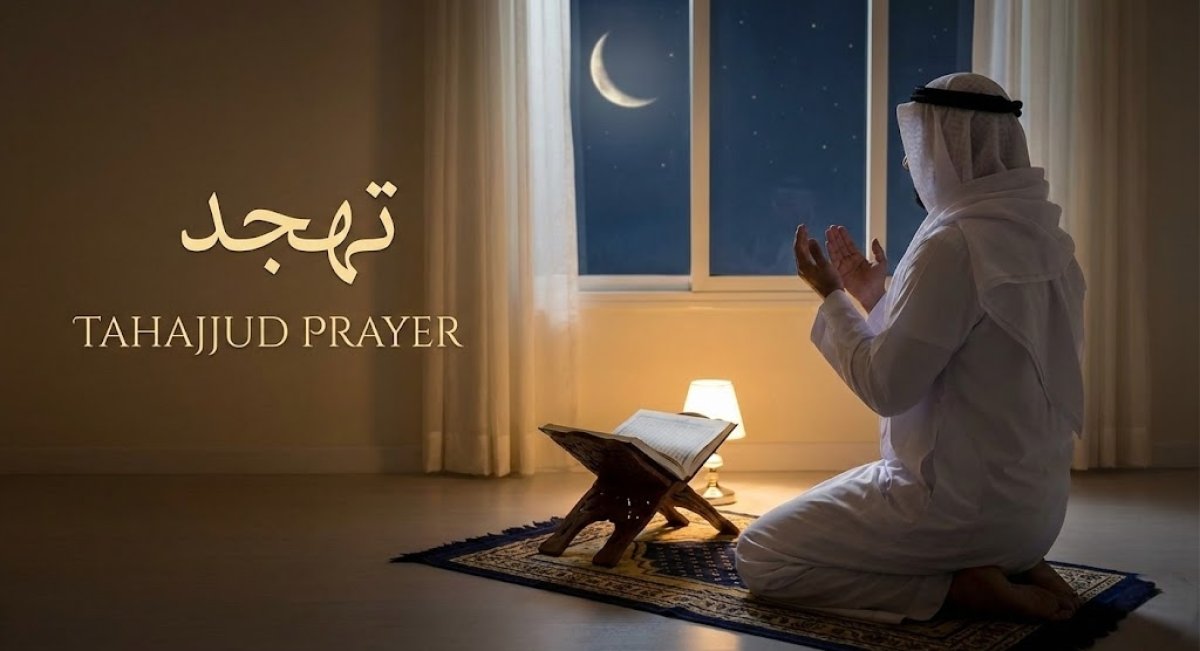
There's a moment in the last third of every night that most people never experience.
The world is asleep. The streets are silent. The distractions have faded.
And in that profound stillness, Allah Himself descends to the lowest heaven and calls out:
مَنْ يَدْعُونِي فَأَسْتَجِيبَ لَهُ؟ مَنْ يَسْأَلُنِي فَأُعْطِيَهُ؟ مَنْ يَسْتَغْفِرُنِي فَأَغْفِرَ لَهُ؟
"Who is calling upon Me so I may answer him? Who is asking of Me so I may give him? Who is seeking My forgiveness so I may forgive him?" (Sahih al-Bukhari)
This is Allah—the Creator of the heavens and the earth, the Sustainer of all existence—personally inviting you to speak to Him.
Waiting for you to ask. Ready to give. Eager to forgive.

And where are most people during this invitation? Asleep. Unconscious. Missing the most powerful moment of the entire day.
But there's a group of people who don't miss it.
People who set their alarms. People who drag themselves out of warm beds. People who stand in the darkness, sometimes alone, sometimes in tears, speaking to their Lord when no one else is watching.
These are the people who pray Tahajjud—the night prayer.
And their lives look different because of it.
What Exactly Is Tahajjud?
Let's start with clarity.
Tahajjud is a voluntary night prayer performed after you've slept and then woken up—ideally in the last third of the night, before the time for Fajr begins.
The word "Tahajjud" comes from the Arabic root hajada, which means to abandon sleep.
You're literally abandoning the comfort of sleep to stand before Allah.
It's not the same as Witr, though many people confuse the two. Witr is the prayer performed after Isha and before Fajr, and it's strongly emphasized to the point where some scholars consider it nearly obligatory.
Tahajjud is specifically the prayer you perform after sleeping and waking up.
The Prophet Muhammad ﷺ never abandoned Tahajjud.
And Allah commanded him specifically:
وَمِنَ اللَّيْلِ فَتَهَجَّدْ بِهِ نَافِلَةً لَّكَ عَسَىٰ أَن يَبْعَثَكَ رَبُّكَ مَقَامًا مَّحْمُودًا
"And during the night, arise for it as an additional prayer for you; perhaps your Lord will resurrect you to a praised station." (Quran 17:79)
This was a specific command to the Prophet ﷺ, but the Companions understood it as a strong encouragement for all believers.
And throughout Islamic history, every single person known for righteousness, knowledge, and closeness to Allah has been a person of the night prayer.
Why Tahajjud Is the Most Powerful Prayer You Can Perform
The Prophet ﷺ was asked which prayer is best after the obligatory prayers.
Without hesitation, he said:
أَفْضَلُ الصَّلَاةِ بَعْدَ الصَّلَاةِ الْمَكْتُوبَةِ الصَّلَاةُ فِي جَوْفِ اللَّيْلِ
"The best prayer after the obligatory prayers is prayer in the depths of the night." (Sahih Muslim)
Not Duha. Not the Sunnah Rawatib. Not any other voluntary prayer.
Tahajjud. The night prayer. That's the pinnacle.
But why? What makes this prayer so special?
The answer lies in what's happening during those hours.
Allah descends to the lowest heaven during the last third of the night.
This is when the barrier between heaven and earth is thinnest and the duas are most readily answered.
The scholars explain that the last third of the night is characterized by five qualities that make it uniquely powerful:
First, it's a time of divine mercy.
Allah is calling out to His servants, inviting them to ask, to seek, to repent. That invitation doesn't exist at any other time with the same intensity.
Second, it's a time of sincerity.
When you wake up at 2 or 3 AM to pray, no one sees you. No one praises you. You're not performing for an audience. It's just you and Allah.
It removes the poison of showing off and ensures your worship is pure.
Third, it's a time of sacrifice.
You're giving up the comfort of sleep—one of the most primal human needs—to stand before your Creator. That sacrifice proves to Allah, and to yourself, that you value His pleasure more than your comfort.
Fourth, it's a time of mental clarity.
Your mind isn't cluttered with the day's worries, responsibilities, or distractions. You're not thinking about work deadlines, family issues, or social obligations.
Fifth, it's a time when Shaytan is less active.
While he's chained during Ramadan, he's generally weaker during the night when most people are sleeping. Your prayer is less likely to be contaminated by whispers, distractions, or laziness.
These five factors combine to create the perfect environment for transformation.
And that's exactly what happens to people who pray Tahajjud consistently—they transform.
The Timing: When Exactly Is the Last Third of the Night?
This is where most people get confused.
What exactly is "the last third of the night"?
Here's how you calculate it: take the time between Maghrib (sunset) and Fajr (dawn), divide that period into three equal parts, and the last third is your target time.
For example, if Maghrib is at 6:00 PM and Fajr is at 6:00 AM, that's 12 hours. Divide by three and you get four-hour segments. The last third would begin at 2:00 AM and end at 6:00 AM.
The calculation changes daily because the times of Maghrib and Fajr change throughout the year.
In winter, when nights are longer, the last third might start around 3:00 AM. In summer, when nights are shorter, it might start at 1:30 AM.
The point is: you need to calculate it based on your location and date.
Many Islamic apps and websites provide this calculation automatically.
Now, here's the good news: you don't have to pray during the entire last third.
Even if you wake up just 30 minutes before Fajr and pray two rak'ahs, you've prayed Tahajjud.
Even if you wake up an hour before Fajr and pray, you've caught the blessed time.
The Prophet ﷺ himself would vary.
Sometimes he would wake up early in the last third and pray for an hour or more. Other times he would wake up closer to Fajr and pray briefly.
The key is waking up after sleep and praying before Fajr.
This is exactly what we see in the Sunnah of the mornings of Prophet Muhammad.
His day did not begin at sunrise.
It began in the quiet darkness before Fajr, when he would wake up and turn to Allah in deep, sincere prayer.
How to Pray Tahajjud: The Step-by-Step Method
Tahajjud is prayed in units of two rak'ahs each, like all voluntary prayers.
You can pray as few as two rak'ahs or as many as you're able. The Prophet ﷺ most commonly prayed either eight or eleven rak'ahs total, but he varied.
Here's the exact method:
Start by making wudu. This is non-negotiable.
You cannot pray without wudu, and the act of washing yourself with cool water also helps wake you up fully.
Begin with the intention in your heart.
You don't need to say it out loud. Simply intend that you're praying Tahajjud for the sake of Allah.
Pray two rak'ahs.
Raise your hands, say "Allahu Akbar," and begin.
Recite Surah Al-Fatihah followed by any other portion of the Quran you know. The Prophet ﷺ would recite long portions—sometimes an entire Juz in one rak'ah—but if you only know short surahs, that's perfectly fine.
After completing two rak'ahs, give salam to end the prayer. Then pray another two. Then another two.
Each set of two is separate.
The Prophet ﷺ would pray slowly. Deliberately.
He would stand until his feet swelled. He would recite with reflection. He would bow with humility. And in sujood—prostration—he would sometimes cry.
After you've prayed as many rak'ahs as you planned, you can finish with Witr if you haven't already prayed it after Isha.
Witr is one or three rak'ahs that conclude your night worship. The Prophet ﷺ said:
اجْعَلُوا آخِرَ صَلَاتِكُمْ بِاللَّيْlِ وِتْرًا
"Make the last of your prayers at night Witr." (Sahih al-Bukhari)
So the typical structure might look like this: two rak'ahs, two rak'ahs, two rak'ahs, two rak'ahs, then three rak'ahs of Witr.
That's eleven total, which was the Prophet's ﷺ most common practice.
But remember—there's no strict rule.
If you can only pray two rak'ahs, pray two. If you can pray eight, pray eight. The key is consistency, not quantity.
What to Recite During Tahajjud
The Prophet ﷺ would recite long portions of the Quran during Tahajjud.
He would sometimes recite an entire Juz (30 pages) in a single night.
But for most people, that's not realistic when starting.
So what should you recite?
At minimum, recite Surah Al-Fatihah in every rak'ah. That's obligatory. After Al-Fatihah, you can recite any surah or portion of the Quran you know.
If you've memorized longer surahs like Al-Baqarah, Al-Kahf, or Ya-Sin, Tahajjud is the perfect time to recite them. The night prayer is when long recitation feels natural, not rushed.
If you only know shorter surahs, that's perfectly acceptable. Recite what you know with focus and reflection.
The Prophet ﷺ said that one verse recited with understanding and contemplation is better than an entire Quran recited without thought.
Some people like to hold a Mushaf (physical Quran) and read directly from it during Tahajjud.
This is permissible and actually recommended because it allows you to recite portions you haven't memorized. The Prophet's ﷺ wife Aisha (may Allah be pleased with her) would do this.
The Dua in Tahajjud
The dua you make during Tahajjud is more likely to be answered than dua at any other time.
The Prophet ﷺ said:
أَقْرَبُ مَا يَكُونُ الرَّبُّ مِنَ الْعَبْدِ فِي جَوْفِ اللَّيْلِ الْآخِرِ، فَإِنِ اسْتَطَعْتَ أَنْ تَكُونَ مِمَّنْ يَذْكُرُ اللَّهَ فِي تِلْكَ السَّاعَةِ فَكُنْ
"The closest the Lord comes to His servant is in the depths of the last portion of the night. So if you are able to be among those who remember Allah in that hour, then be so." (Tirmidhi)
This is your golden opportunity. Don't waste it.
After completing your rak'ahs, sit on your prayer mat and make dua. Not for five seconds. Not in a rushed, automatic way. Take your time. Pour your heart out.
The Prophet ﷺ would make extensive dua during the night prayer.
He would cry.
He would repeat the same dua multiple times. He would ask for big things and small things. He would pray for himself, his family, his community, and the entire Ummah.
There's no specific dua you must say. Speak to Allah in your own words. In Arabic if you can, in your native language if you can't.
Allah understands all languages.
Ask for forgiveness. Ask for guidance. Ask for provision. Ask for healing. Ask for Jannah. Ask for protection from the Fire. Ask for your parents. Ask for your children. Ask for the oppressed Muslims around the world.
And don't hold back.
Don't think your sins are too big. Don't think your requests are too bold. The Prophet ﷺ encouraged us to ask Allah for everything, even something as small as a broken sandal strap.
This is the time when Allah is saying, "Ask Me." So ask. Abundantly. Sincerely. With certainty that He will respond.
The Obstacles: Why People Quit (And How to Overcome Them)
Let's be honest.
Most people who try to pray Tahajjud quit within a week.
They set their alarm. They wake up groggy and disoriented. They drag themselves out of bed, pray two rak'ahs half-asleep, and then collapse back into bed. After a few days of this, they give up, thinking "This isn't for me."
But the problem isn't Tahajjud. The problem is approach.
The first obstacle is going to bed too late.
If you're staying up until midnight or 1 AM, waking up at 3 AM for Tahajjud becomes nearly impossible.
You need at least four hours of sleep before attempting to wake up.
So if you want to pray Tahajjud at 3 AM, you need to be asleep by 11 PM at the latest.
This is also why the nightly routine of Prophet Muhammad focused on resting early instead of staying up without need.
After Isha, he preferred sleep over long, unnecessary conversations.
The second obstacle is relying solely on willpower.
Willpower is weakest when you've just woken up. Your bed is warm. Your body is tired. And the voice in your head is screaming, "Just five more minutes."
The solution is to remove the decision-making.
Set your alarm across the room so you have to physically get up to turn it off. Once you're standing, go directly to the bathroom and make wudu. Don't give yourself the option to go back to bed.
The third obstacle is praying too long when starting out.
Many people think they need to pray for an hour to make it worthwhile. So they set an unrealistic goal, fail to maintain it, and quit.
Start with just two rak'ahs.
That's it.
Five minutes. If that's all you can do consistently for a month, you've succeeded. Once it becomes a habit, you can gradually increase.
The fourth obstacle is inconsistency.
People try to pray Tahajjud every night from day one, burn out within a week, and quit entirely.
Instead, start with just two nights a week. Monday and Thursday, for example.
Build the habit gradually.
Once that's consistent for a month, add a third night. Then a fourth. Slow and steady wins.
The fifth obstacle is doing it alone. When you're struggling to wake up and there's no accountability, it's easy to quit.
Find a Tahajjud partner. A friend, a spouse, a family member. Someone who will check on you.
Someone you can text when you wake up.
Community and accountability make everything easier.
What Happens When You Pray Tahajjud Consistently
People who pray tahajjud regularly make better decisions.
Something about starting the day with clarity and connection to Allah makes the rest of the day's choices easier.
They're less reactive, less impulsive, less likely to follow their desires.
They feel more at peace.
The anxiety that used to plague them starts to fade. They sleep better, even with less sleep, because their hearts are at rest.
The constant worry about the future diminishes because they've placed their trust in Allah.
They notice their duas being answered. Doors open that they didn't even know existed.
Opportunities appear. Problems resolve themselves. Relationships improve. Provisions increase.
They become more disciplined in other areas.
If you can wake up at 3 AM to pray, you can do anything.
They develop a stronger relationship with the Quran. When you're reciting long portions during Tahajjud, you naturally start to memorize more, understand more, and reflect more. The Quran stops being a book you read and becomes a conversation you have.
They notice their character improving.
They're more patient, more kind, more forgiving.
The things that used to make them angry barely register anymore. They're more generous with their time, money, and energy.
And most importantly, they feel closer to Allah.
Not in some abstract, theoretical way, but in a tangible, experiential way. They feel His presence. They sense His guidance. They trust His plan.
The Connection to the Prophetic Routine
Tahajjud was never a separate act of worship in the life of Prophet Muhammad (PBUH).
It was part of a complete daily rhythm built around prayer and remembrance.
He would usually sleep early after Isha, knowing that proper rest makes waking at night easier.
Over time, his body became naturally aligned with this pattern of worship, allowing him to wake without the need for an alarm.
When he woke, he began with wudu — not only as preparation for prayer, but also as a way to refresh himself and become fully alert.
After praying Tahajjud, he did not simply return to sleep. Instead, he remained engaged in dhikr, recitation of the Quran, and quiet preparation for Fajr.
He then prayed Fajr on time and stayed seated remembering Allah until sunrise, followed by the Ishraq prayer — two rak‘ahs carrying immense reward.
This flow — sleeping early, rising for Tahajjud, remaining awake in remembrance, and continuing with the morning prayers — reflects the broader structure explained in a previous complete Sunnah prayers guide.
The goal is not to add a single prayer occasionally, but to shape your nights and mornings around consistent worship.
When a person lives by this pattern, Tahajjud becomes more than an extra prayer. It becomes part of a lifestyle — one that begins each day with calm, focus, and a deep connection with Allah.
How to Start Tonight
You don't need to wait for the perfect time. You don't need to prepare for weeks. You can start tonight.
Here's your simple plan:
Go to sleep within two hours after Isha. Turn off your phone. Stop scrolling. Get in bed and rest.
Set your alarm for one hour before Fajr. Just one hour. That's your target.
When the alarm goes off, don't think. Don't negotiate with yourself. Just stand up and walk to the bathroom.
Make wudu.
Pray two rak'ahs. That's it. Just two. Don't try to pray for an hour. Just two focused, sincere rak'ahs.
Then sit on your prayer mat and make dua. For five minutes. Pour your heart out. Ask for whatever you need.
Stay awake until Fajr.
Don't go back to bed. Read Quran. Make more dhikr.
Start your day from here!
Do this tonight. Then do it again tomorrow night. Then again the night after.
For 30 days, just commit to two rak'ahs, one hour before Fajr.
After 30 days, you'll notice changes. You'll feel different. And you'll wonder why you waited so long to start.
The Ultimate Goal: Becoming One of Allah's Beloved
The Quran describes the people of Tahajjud with the highest praise:
كَانُوا قَلِيلًا مِّنَ اللَّيْلِ مَا يَهْجَعُونَ • وَبِالْأَسْحَارِ هُمْ يَسْتَغْفِرُونَ
"They used to sleep but little of the night, and in the hours before dawn, they would ask forgiveness." (Quran 51:17-18)
This is who you want to become.
Not someone who occasionally prays Tahajjud when they feel motivated. But someone who makes it a part of who they are.
Someone who answers Allah's call every single night. Someone whose bed may be warm, but whose desire to stand before their Lord is stronger.
That's the ultimate goal.
Not praying for hours every night. Just consistency. Just refusing to let the night pass without at least attempting to answer the call.
So start tonight.
Wake up. Pray. And join the ranks of those who've discovered the secret that changes everything.
