Today is February 5, 2026.
In exactly 13 days, the blessed month of Ramadan will begin on February 18, insha'Allah.
That means you have less than two weeks to prepare—not just your pantry and your schedule, but your heart, your habits, and your entire approach to worship.
Most people wait until the first day of Ramadan to "get serious." They assume they can just flip a switch and suddenly become disciplined, focused, and connected to Allah.
But that's not how transformation works.
You can't expect to run a marathon if you haven't trained. You can't expect to excel in Ramadan if you haven't prepared.
The scholars used to make dua for six months asking Allah to allow them to reach Ramadan.
Then they'd make dua for six months after asking Him to accept it. They understood something most of us have forgotten: Ramadan rewards those who prepare for it.
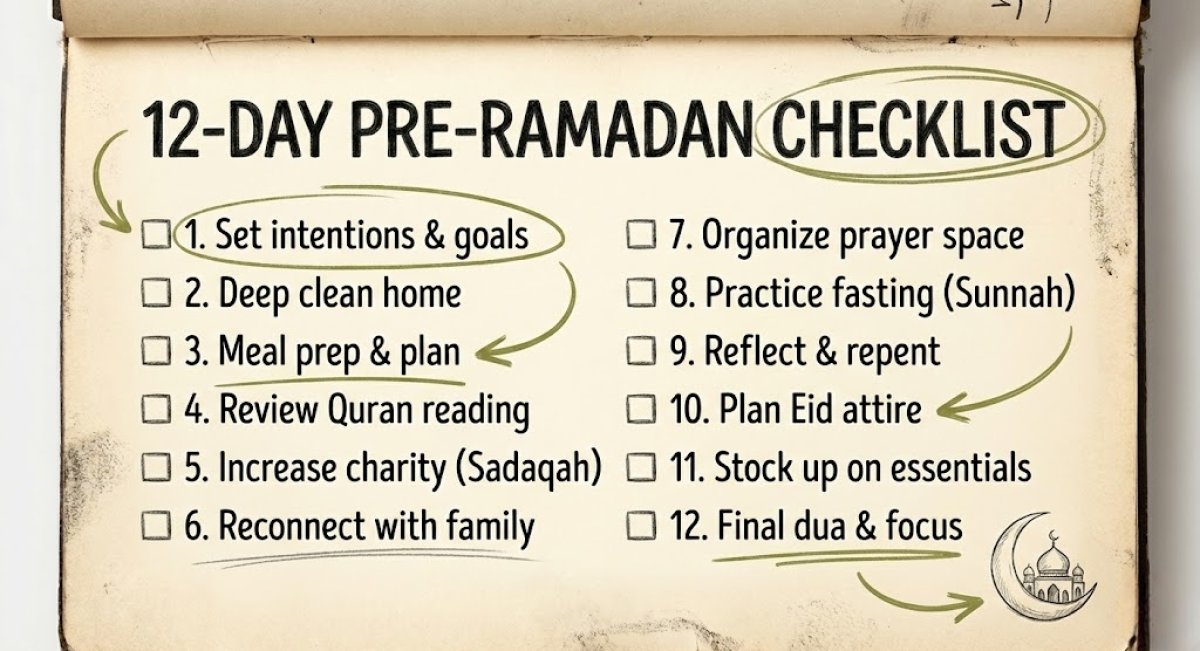
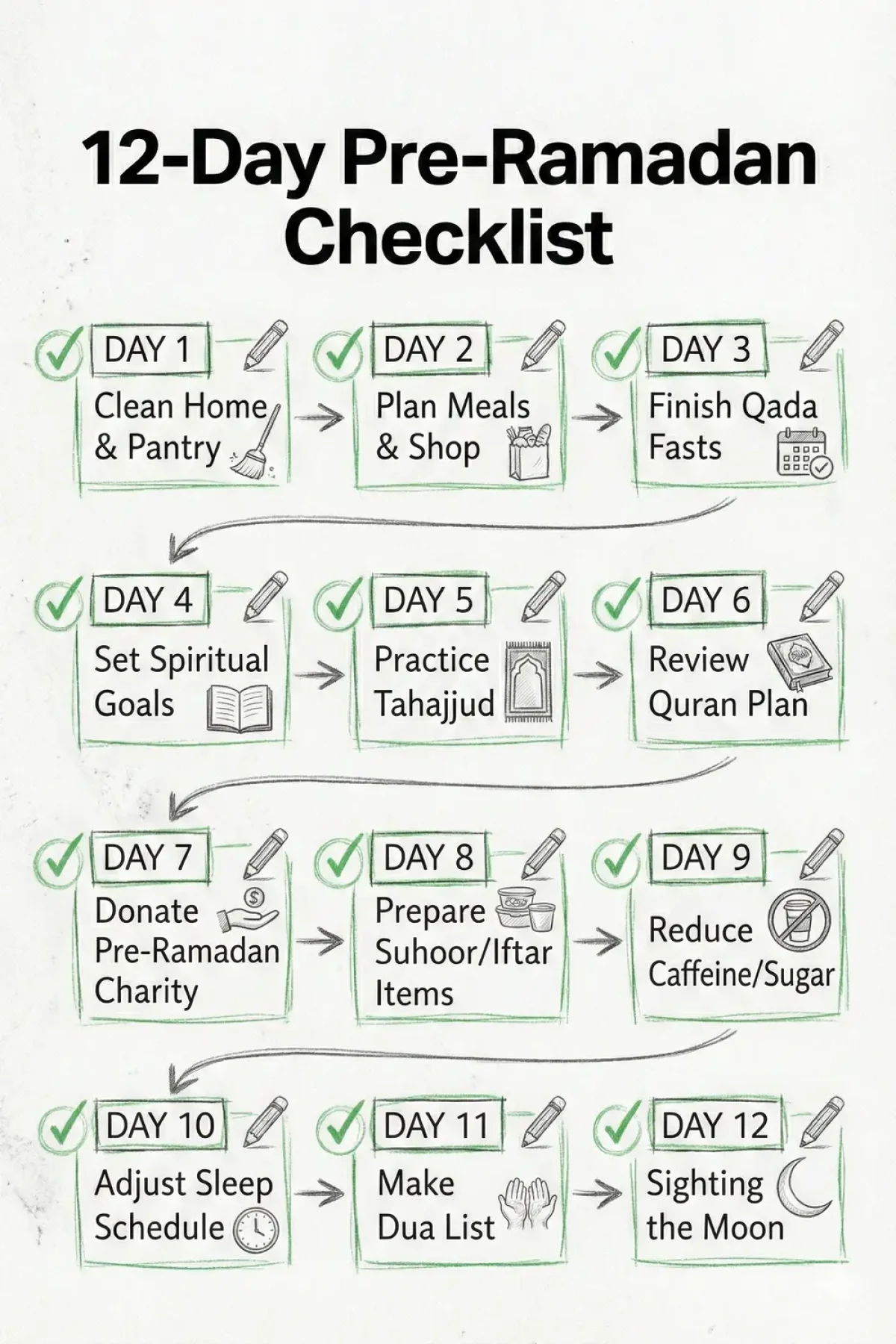
So we designed a 12 days pre-ramadan checklist you can follow to be prepared.
Day 1 (February 5): Make Sincere Tawbah for Every Major Sin
Take 30 minutes today to write down every major sin you can remember from the past year.
Then make sincere repentance for each one.
You can't fill a cup that's already full. Your heart is like that cup. If it's filled with guilt, regret, and unresolved sin, there's no room for Allah's mercy.
Ramadan is about receiving forgiveness—but you have to ask for it first.
How to Do It:
-
Find a private space where you won't be interrupted.
-
Write down your sins on paper or your phone:
- Missed prayers
- Lying, backbiting, gossip
- Haram relationships or content
- Disobeying parents
- Wasting time on meaningless things
- Anything you regret
-
Go through the list one by one and say:
"Ya Allah, I acknowledge that I committed [sin]. I was wrong. I regret it deeply. Please forgive me, and help me never return to it." -
Make this dua:
اللَّهُمَّ إِنِّي ظَلَمْتُ نَفْسِي ظُلْمًا كَثِيرًا، وَلَا يَغْفِرُ الذُّنُوبَ إِلَّا أَنْتَ، فَاغْفِرْ لِي مَغْفِرَةً مِنْ عِنْدِكَ، وَارْحَمْنِي، إِنَّكَ أَنْتَ الْغَفُورُ الرَّحِيمُ
"O Allah, I have greatly wronged myself, and no one forgives sins except You. So forgive me with forgiveness from You, and have mercy on me. Indeed, You are the Forgiving, the Merciful." (Sahih al-Bukhari)
- Destroy the list. Tear up the paper or delete the file. Those sins are gone (inshallah). Don't carry them into Ramadan.
You enter Ramadan with a clean slate, a lighter heart, and the confidence that Allah has accepted your repentance.
Day 2 (February 6): Forgive Everyone Who Wronged You
Make a mental list of everyone who hurt you, betrayed you, or wronged you. Then forgive each person for the sake of Allah.
The Prophet ﷺ said that Allah looks at His creation on the night of the 15th of Sha'ban and forgives everyone except two groups: those who associate partners with Him, and those who harbor enmity (Ibn Majah).
Holding grudges blocks your forgiveness from Allah. Is your grudge worth that?
How to Do It:
-
Identify the people who wronged you. Don't write their names—just think of them.
-
For each person, say out loud:
"I forgive [name] for the sake of Allah. Ya Allah, guide them, forgive them, and remove the bitterness from my heart." -
Make this dua:
اللَّهُمَّ إِنِّي أَعُوذُ بِكَ مِنَ الْحِقْدِ وَالْحَسَدِ
"O Allah, I seek refuge in You from hatred and envy."
- If possible, reach out to someone you've been distant from. Send a message. Make peace. Life is too short to hold grudges.
Important: forgiveness doesn't mean what they did was okay. It doesn't mean you have to be best friends. It means you're releasing the anger from your heart so you can move forward.
You enter Ramadan with a heart free from resentment, ready to receive Allah's mercy without barriers.
Day 3 (February 7): Start Reading the Quran Daily (Just 2 Pages)
Read exactly 2 pages of the Quran today.
Not 10 pages. Not a full Juz. Just 2 pages.
Most people wait until Ramadan to open the Quran, and then they wonder why it feels heavy and they can't continue.
The Quran responds to consistency.
If you've been away from it for months, it will feel foreign. But if you rebuild the relationship now, Ramadan will feel like reuniting with an old friend.
How to Do It:
-
Choose any Surah you want to read. If you're unsure, start with Surah Al-Baqarah.
-
Read slowly. Don't rush. Understand what you're reading.
-
Reflect on one verse. When something stands out, pause and ask: What is Allah telling me?
-
Make this dua before you start:
اللَّهُمَّ افْتَحْ عَلَيَّ فُتُوحَ الْعَارِفِينَ
"O Allah, open for me the openings of those who truly know You."
By the time Ramadan arrives, you'll have read 24 pages—almost a full Juz.
More importantly, you'll have conditioned your heart to engage with Allah's words.
When Ramadan begins and you start reading more Quran, it won't feel like a burden.
It will feel like coming home.
Day 4 (February 8): Fast Today (Practice Fast)
Fast from Fajr to Maghrib today, even though it's not Ramadan yet.
The Prophet ﷺ used to fast extensively in Sha'ban (Sahih al-Bukhari).
Why?
Because it's Ramadan's training camp. If you go from eating three meals a day to suddenly fasting for 13+ hours, your body will revolt. But if you condition it now, Ramadan will feel easier.
How to Do It:
- Wake up for Suhoor just like you would in Ramadan.
- Make your intention to fast for the sake of Allah.
- Go about your day as normal—work, school, errands.
- Break your fast at Maghrib with dates and water.
- Reflect: How did you feel? Where did you struggle? What can you improve?
Bonus:
If today is a Monday or Thursday, you're following the Sunnah of fasting on these days (Tirmidhi).
Your body and mind start adjusting to the rhythm of fasting.
When Ramadan arrives, you won't feel the shock—you'll feel prepared.
Day 5 (February 9): Set Clear, Measurable Goals for Ramadan
Write down exactly what you want to accomplish in Ramadan 2026.
Be specific. Be measurable.
Because, a goal without a plan is just a wish.
Most people enter Ramadan thinking, "I'll try to be better." That's too vague. What does "better" mean?
How will you measure it?
Here is how you can do it:
Create three categories:
1. Worship Goals:
- Finish the Quran at least once
- Pray Tahajjud 20 out of 30 nights
- Make dua for 15 minutes before every Iftar
- Give Sadaqah daily (even $1)
2. Character Goals:
- Control my anger—count to 10 before reacting
- Stop backbiting completely
- Be kinder to my parents
- Lower my gaze consistently
3. Post-Ramadan Goals:
- Continue praying Fajr on time
- Read 2 pages of Quran daily
- Fast Mondays and Thursdays
Write them down. Put the list somewhere visible—on your phone, on your wall, in your journal.
You enter Ramadan with a clear roadmap.
You know exactly what success looks like, and you can measure your progress daily.
Day 6 (February 10): Delete Social Media Apps (7-Day Detox)
Delete Instagram, TikTok, Facebook, YouTube, and any other app that steals your time and attention.
For the next 7 days, stay off social media completely.
You can't claim you don't have time to read Quran when you're spending 3 hours a day scrolling.
Social media is designed to be addictive. It hijacks your attention, fragments your focus, and fills your mind with noise. Ramadan requires clarity.
This detox gives you that.
How to Do It:
- Track your screen time first. See how many hours you're actually spending.
- Delete the apps. Not just log out—DELETE them.
- Replace the habit. When you reach for your phone, open the Quran app instead.
- Make this dua:
اللَّهُمَّ إِنِّي أَعُوذُ بِكَ مِنْ عِلْمٍ لَا يَنْفَعُ، وَعَمَلٍ لَا يُرْفَعُ، وَدُعَاءٍ لَا يُسْمَعُ
"O Allah, I seek refuge in You from knowledge that does not benefit, deeds that are not accepted, and supplications that are not heard."
By Day 3, your mind will feel clearer. By Day 7, you won't even miss it.
And when Ramadan begins, you won't be distracted by notifications, trends, or meaningless content.
Your attention will be fully on worship.
Day 7 (February 11): Reconcile Broken Relationships
Reach out to at least one person you've been distant from—a family member, a friend, someone you had a falling out with. Make peace.
The Prophet ﷺ said, "It is not lawful for a Muslim to forsake his brother for more than three days" (Sahih al-Bukhari).
Broken relationships create barriers in your heart.
You can't fully connect with Allah when you're harboring resentment or unresolved conflict.
How to Do It:
-
Send a message. It doesn't have to be long. Just: "Assalamu alaikum. I've been thinking about you. I hope you're well. Let's talk."
-
If you were wrong, apologize. Say: "I'm sorry for [specific action]. I was wrong. Can we move past this?"
-
If they wronged you, extend grace. Say: "I forgive you. Let's start fresh."
-
If they don't respond, you've done your part. Allah sees your effort.
You enter Ramadan with a clear conscience, knowing you've done everything possible to mend what was broken.
Day 8 (February 12): Create a Ramadan Dua List
Write down 20-30 specific things you want to ask Allah for during Ramadan.
Most people make vague, random duas. "Ya Allah, help me." Help you with what? Be specific. The Prophet ﷺ said, "Call upon Allah while being certain of being answered" (Tirmidhi). Specificity shows intention.
Organize your duas into categories:
Akhirah:
- Jannah al-Firdaus
- Protection from Jahannam
- Good ending (husnul khatimah)
- Ease in the grave
Forgiveness:
- Specific sins you want erased
- Habits you want to break
- People you've hurt (ask Allah to heal them)
Personal Growth:
- Patience, humility, gratitude
- Love for Allah and His Messenger ﷺ
- Consistency in worship after Ramadan
Family:
- Guidance for parents, spouse, children
- Healing for the sick
- Provision for those in need
Worldly Needs:
- Halal income, financial stability
- A righteous spouse (if unmarried)
- Success in work/studies
Ummah:
- Palestine, Gaza, Syria, Sudan—all oppressed Muslims
- Guidance for those who've lost their way
- Unity of the Muslim Ummah
When Ramadan begins, you won't waste your golden hours wondering what to ask for.
You'll have a clear, comprehensive list ready to go.
Day 9 (February 13): Start Waking Up for Fajr on Time (Every Day Until Ramadan)
For the next 5 days (Feb 13-17), wake up for Fajr on time—every single day.
If you can't wake up for Fajr before Ramadan, you won't wake up during Ramadan. And if you miss Fajr during Ramadan, you're missing one of the five pillars of Islam.
This is non-negotiable.
How to Do It:
- Set 3 alarms at different intervals.
- Put your phone across the room so you have to get up to turn it off.
- Sleep early. You can't wake up for Fajr if you sleep at 2 AM.
- Make this dua before sleeping:
اللَّهُمَّ أَحْيِنِي عَلَى أَحْسَنِ حَالٍ وَأَمِتْنِي عَلَى أَحْسَنِ حَالٍ
"O Allah, let me live in the best state and die in the best state."
Mark each day you wake up for Fajr.
By February 17, you should have 5 checkmarks.
When Ramadan begins, waking up for Suhoor and Fajr will feel natural, not like a battle.
Day 10 (February 14): Practice Praying Tahajjud (Just 2 Rak'ahs)
Tonight, set your alarm for 3 AM.
Wake up. Make wudu. Pray 2 rak'ahs of Tahajjud.
Then go back to sleep.
The last ten nights of Ramadan require Tahajjud. If you've never prayed it before, those nights will feel impossible. But if you train your body now, it will be ready.
How to Do It:
- Set your alarm for 3 AM (last third of the night).
- Wake up and make fresh wudu.
- Pray 2 slow, focused rak'ahs.
- In sujood, make dua for 2-3 minutes.
- Go back to sleep.
Make this dua during Tahajjud:
اللَّهُمَّ لَكَ الْحَمْدُ أَنْتَ نُورُ السَّمَاوَاتِ وَالْأَرْضِ
"O Allah, to You belongs all praise. You are the Light of the heavens and the earth." (Sahih al-Bukhari)
When the last ten nights arrive, your body will already know what to do. Tahajjud won't feel foreign—it will feel familiar.
Day 11 (February 15): Stock Your Home with Ramadan Essentials
Buy everything you'll need for Ramadan so you're not scrambling on Day 1.
You don't want to spend the first day of Ramadan running to the grocery store. Prepare now so you can focus on worship when the month begins.
The Checklist:
Food:
- Dates (for Iftar)
- Oats, fruits, nuts (for Suhoor)
- Water, milk, juice
- Easy-to-cook meals (so you're not spending hours in the kitchen)
Religious Items:
- Quran (physical or app)
- Prayer mat
- Tasbeeh (prayer beads)
- Islamic books or lectures downloaded
Practical Items:
- Alarm clock (backup for your phone)
- Water bottle (to remind you to hydrate after Iftar)
- Notebook (for dua list and Ramadan reflections)
When Ramadan begins, you're fully equipped.
No stress, no last-minute trips. Just focus.
Day 12 (February 16): Make This Powerful Dua to Reach Ramadan
Today and tomorrow (Feb 16-17), make this dua constantly:
اللَّهُمَّ بَلِّغْنَا رَمَضَانَ
"O Allah, allow us to reach Ramadan."
Not everyone will reach Ramadan.
Some people are planning for it right now, but they won't make it. Death doesn't wait.
So ask Allah—sincerely, desperately—to allow you to reach this blessed month.
Here is How to Do It:
Say it:
- After every Salah
- Before sleeping
- When you wake up
- Throughout the day
Pair it with this full dua:
اللَّهُمَّ بَارِكْ لَنَا فِي رَجَبَ وَشَعْبَانَ وَبَلِّغْنَا رَمَضَانَ
"O Allah, bless us in Rajab and Sha'ban and allow us to reach Ramadan."
And when Ramadan arrives, you won't take it for granted. You'll wake up on Day 1 with gratitude, knowing that Allah answered your dua and granted you this opportunity.
February 17: The Day Before Ramadan
Tomorrow is Ramadan.
You've completed the 12-day checklist. Now it's time for the final preparation.
Morning:
- Wake up for Fajr on time
- Read 2 pages of Quran
- Review your Ramadan goals
- Check your dua list
Afternoon:
- Rest. Sleep. Conserve your energy.
- Mentally prepare: "Tomorrow, everything changes."
Evening:
- Eat a light, nutritious meal
- Prepare your Suhoor food for tomorrow
- Set 3 alarms for Suhoor
- Charge your phone
- Go to bed early
Before Sleeping, Make This Dua:
اللَّهُمَّ اجْعَلْ هَذَا رَمَضَانَ خَيْرَ رَمَضَانٍ مَرَّ عَلَيَّ
"O Allah, make this Ramadan the best Ramadan I've ever experienced."
Now You Are Ready!
You've made Tawbah. You've forgiven. You've reconnected with the Quran. You've trained your body. You've set your goals. You've cleansed your heart.
You are READY.
Tomorrow, when the first fast begins, you won't be starting from zero. You'll be starting from a place of strength, clarity, and intention.
And if you want daily guidance to stay consistent throughout the entire month, the journey continues with Ramadan Day 1, where you'll receive specific duas, tasks, and prayer times to structure each day of this blessed month around worship and transformation.
This Ramadan won't be like the others. This one will be different.
Because you prepared for it.
