February 5, 2026
How Many Times to Read Manzil Dua?
scholars and many pious people suggest reading the entire collection once in the morning and once in the evening.
Read Article →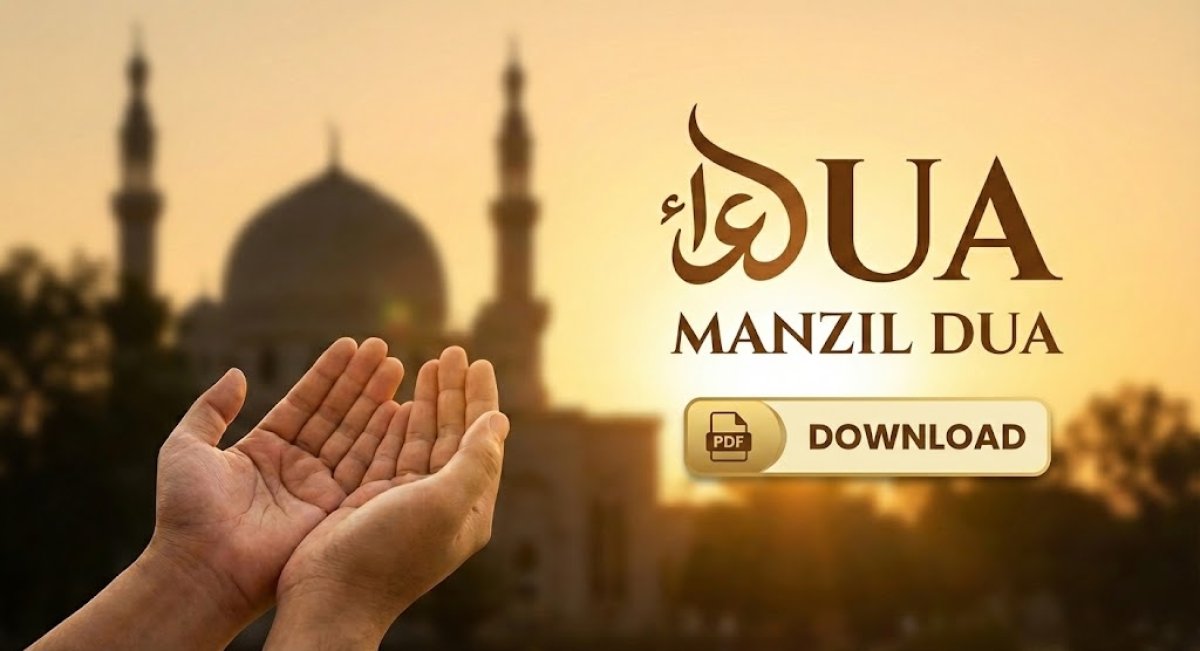
There are certain practices that travel through families — from grandmother to mother to child — without much explanation attached.
People just do it.
They read it in the morning before school, again in the evening after Maghrib, and somewhere in the middle of life they realize this practice has been with them for as long as they can remember.
Manzil is one of those practices — at least in South Asian Muslim households.
But in recent years, more people have started asking questions.
Where did this come from? Is it from the Quran or the Sunnah? Who selected these verses and why? Is it even permissible to recite them in this compiled form?
These are fair questions, and they deserve honest answers. This article goes through all of it — the origin, the full list of verses, what makes each verse significant, and what the scholars actually say about its basis.
Note: If you want to download it as a PDF and want to print it, download the pdf version from bellow link:
Recite it every morning or evening and feel its blessings in your daily life.
Manzil is a collection of 33 sets of verses from the Quran, drawn from 14 different Surahs, compiled for the purpose of protection — against the evil eye, black magic (sihr), jinn, harmful whisperings, and general calamity.
The word مَنْزِل in Arabic means a dwelling place, a station, or a resting place.
The name suggests exactly what the practice is meant to provide: a place of safety, a shield around the one who recites.
It is not a Surah in the Quran.
It is not a dua invented by anyone.
Every word in it is the word of Allah — verses from the Quran, chosen specifically because of their protective nature and proven effectiveness as ruqyah.
This is where many people get confused.
Some assume it is a completely modern invention. Others assume it has been practiced since the time of the Companions.
The Manzil as a compiled collection was given formal structure and spread by Shaykh al-Hadith Mawlana Muhammad Zakariyya al-Kandhlawi (رحمه الله), one of the most prominent Hadith scholars of the twentieth century, known for his monumental work Awjaz al-Masalik — a detailed commentary on Muwatta Imam Malik.
The Kandhlawi family treated the Manzil with great importance and made it a tradition to ensure women and children in the household memorized it.
But the selection of these verses was not arbitrary.
According to Mawlana Talha, the son of Shaykh Zakariyya, the Manzil is rooted in a narration found in the Mustadrak of Imam al-Hakim (vol. 4, p. 413).
The narration is recorded as follows:
Ubayy ibn Ka'b (رضي الله عنه) said:
I was with the Messenger of Allah ﷺ when a bedouin came and said: "O Prophet of Allah, I have a brother who has a problem." The Prophet ﷺ asked what the problem was. The man said his brother suffered from a kind of mental affliction. The Prophet ﷺ told him to bring his brother. When the man came, the Prophet ﷺ recited over him a specific set of verses from the Quran — and when he finished, the man stood up as if he had never had any complaint at all.
The verses the Prophet ﷺ recited in that narration form the core of what we know today as the Manzil.
Imam al-Hakim stated that the narrators of this hadith were accepted by Bukhari and Muslim, with one exception — Abu Jannab al-Kalbi, a narrator found in the chain.
Al-Hakim considered the hadith sound despite this.
However, Imam al-Dhahabi noted that Abu Jannab al-Kalbi was declared weak by al-Daraqutni, and that the hadith is munkar (objectionable).
Scholars differ on this.
Some accept it with the endorsement of al-Hakim; others follow al-Dhahabi's more cautious position.
What is not in dispute is this: every single verse in the Manzil is from the Quran.
And the Quran, in its entirety, is shifa — healing and protection. Reciting it with the intention of seeking Allah's protection is an established and encouraged act, regardless of the specific compilation.
The Prophet ﷺ himself described the Quran as the greatest form of ruqyah.
Scholars like Mufti Taqi Usmani and others from the Deobandi tradition have stated clearly that reciting the Manzil is permissible and beneficial, and that compiling Quranic verses for protective recitation is an act that scholars have engaged in throughout Islamic history — from Hizbul A'zam by Mulla Ali Qari to Al-Mathurat by Imam Hasan al-Banna.
The Manzil comprises the following portions of the Quran:
The verses in the Manzil were not picked at random.
Each group has a particular significance either in establishing tawheed, seeking refuge from harm, or affirming Allah's absolute authority over all creation. Here is a breakdown of each section.
The opening surah of the Quran is itself a complete act of ruqyah.
The Prophet ﷺ himself described it as Umm al-Quran — the mother of the Quran — and in a famous narration, one of the Companions recited it over a man who had been stung, and the man recovered.
The Prophet ﷺ, when he heard what happened, asked the Companion: "How did you know it was a ruqyah?" — a statement understood by scholars as an indication of approval.
Al-Fatihah is a declaration of servitude, a plea for guidance, and an acknowledgment that all praise and all power belong to Allah.
Beginning the Manzil with it sets the entire recitation on the right foundation.
These verses establish the characteristics of the true believer — belief in the unseen, establishing prayer, spending from what Allah has provided.
They also assert that this Quran is guidance for those who are conscious of Allah.
Reciting these at the beginning of a protective reading is a statement of who you are and what you believe.
Before you ask for protection, you declare your identity as a Muslim who accepts the Quran as truth.
Arabic: وَإِلَٰهُكُمْ إِلَٰهٌ وَاحِدٌ ۖ لَّا إِلَٰهَ إِلَّا هُوَ الرَّحْمَٰنُ الرَّحِيمُ
"And your God is one God. There is no deity worthy of worship except Him, the Most Merciful, the Most Compassionate."
This single verse is a complete declaration of tawheed — the oneness of Allah.
It is the theological bedrock that renders all evil powerless.
Sihr, jinn, the evil eye — all of these operate on the premise that something other than Allah has some independent power over you.
This verse is a direct rebuttal of that premise.
اللَّهُ لَا إِلَٰهَ إِلَّا هُوَ الْحَيُّ الْقَيُّومُ ۚ لَا تَأْخُذُهُ سِنَةٌ وَلَا نَوْمٌ ۚ لَّهُ مَا فِي السَّمَاوَاتِ وَمَا فِي الْأَرْضِ ۗ مَن ذَا الَّذِي يَشْفَعُ عِندَهُ إِلَّا بِإِذْنِهِ ۚ يَعْلَمُ مَا بَيْنَ أَيْدِيهِمْ وَمَا خَلْفَهُمْ ۖ وَلَا يُحِيطُونَ بِشَيْءٍ مِّنْ عِلْمِهِ إِلَّا بِمَا شَاءَ ۚ وَسِعَ كُرْسِيُّهُ السَّمَاوَاتِ وَالْأَرْضَ ۖ وَلَا يَئُودُهُ حِفْظُهُمَا ۚ وَهُوَ الْعَلِيُّ الْعَظِيمُ
Ayat al-Kursi is the greatest verse in the Quran — the Prophet ﷺ himself stated this.
Abu Hurairah (رضي الله عنه) narrated the famous story of when Shaytan came to him to steal from the charity of Ramadhan, and before leaving, taught him Ayat al-Kursi — saying that whoever recites it at night, Allah assigns a protector over him and Shaytan will not come near him until morning.
The Prophet ﷺ confirmed what the devil told him was true.
The verses that follow (2:256–257) include the declaration that there is no compulsion in religion, and that Allah is the Waliyy — the Protector — of the believers, taking them from darkness into light.
These three verses are among the most beloved of the entire Quran.
The Prophet ﷺ said in a narration recorded in Sahih Muslim:
Arabic: مَنْ قَرَأَ بِالآيَتَيْنِ مِنْ آخِرِ سُورَةِ الْبَقَرَةِ فِي لَيْلَةٍ كَفَتَاهُ
"Whoever recites the last two verses of Surah Al-Baqarah at night, they will suffice him."
Scholars of hadith have interpreted kafatahu — "suffice him" — to mean sufficient for protection from all harm that night.
The verses themselves contain the believer's declaration of hearing and obeying, an acknowledgment of Allah's absolute knowledge, and the most moving dua in the Quran — Rabbana la tu'akhidhna in nasina aw akhta'na — asking Allah not to hold us accountable for forgetting or making mistakes.
Verse 18 is Allah's testimony to His own oneness — Shahidallahu annahu la ilaha illa huwa — and it is followed by the testimony of His angels and those of knowledge.
There is perhaps no more authoritative testimony in existence.
Verses 26 and 27 acknowledge that all sovereignty, all honor, and all provision are in Allah's hands.
He gives and withholds as He wills. He raises and lowers as He wills. Internalizing this breaks the psychological hold of fear — because once you know all power rests with Allah, there is nothing left to fear.
إِنَّ رَبَّكُمُ اللَّهُ الَّذِي خَلَقَ السَّمَاوَاتِ وَالْأَرْضَ فِي سِتَّةِ أَيَّامٍ ثُمَّ اسْتَوَىٰ عَلَى الْعَرْشِ
These verses assert Allah's creative authority over the heavens and earth, His establishment over the Throne, and His command over the day and night.
Verse 56 contains the command not to cause corruption after the earth has been set right, and the instruction to call upon Allah in fear and hope.
The phrase inna rahmatallahi qaribun minal-muhsineen — "the mercy of Allah is close to those who do good" — ends this section with reassurance.
These closing verses of Surah Al-Isra command the Prophet ﷺ — and by extension all believers — to call upon Allah by any of His beautiful names, and to be neither too loud nor too quiet in prayer.
They affirm Allah's absolute independence and His greatness. Ending with this before moving to other Surahs is a reminder that the one being called upon is Al-Kabir — the incomprehensibly great.
أَفَحَسِبْتُمْ أَنَّمَا خَلَقْنَاكُمْ عَبَثًا وَأَنَّكُمْ إِلَيْنَا لَا تُرْجَعُونَ
"Did you think that We created you without purpose and that you would not be returned to Us?"
This is a rhetorical question that cuts to the heart of human accountability.
The verses that follow exalt Allah above any partner or imperfection, and end with a beautiful plea: Rabbi ighfir warham wa anta khayrur-rahimeen — "My Lord, forgive and have mercy, for You are the best of those who show mercy."
Placing this here in the Manzil reminds the reciter of their place before Allah — not a position that invites despair, but one that invites sincere turning to Him.
These opening verses of Surah Al-Saffat describe the angels arranged in ranks before Allah, those who drive the clouds, and those who recite His glorification.
Verse 7 specifically mentions that the lower heavens are adorned and protected from every rebellious devil — wa hifzan min kulli shaytanin marid. This is a direct statement that the forces of evil are under divine restraint.
Reading these verses is an acknowledgment of that divine barrier.
يَا مَعْشَرَ الْجِنِّ وَالْإِنسِ إِنِ اسْتَطَعْتُمْ أَن تَنفُذُوا مِنْ أَقْطَارِ السَّمَاوَاتِ وَالْأَرْضِ فَانفُذُوا ۚ لَا تَنفُذُونَ إِلَّا بِسُلْطَانٍ
"O company of jinn and mankind, if you are able to pass beyond the regions of the heavens and earth, then pass. You will not pass except by authority — and which of the favors of your Lord will you deny?"
This is a direct address to both jinn and humanity.
It establishes, unambiguously, that neither can operate outside the permission of Allah.
The jinn — who are often the means through which sihr and harm reach people — are being reminded of their own limitation. Reciting this is a statement of that truth.
The last three verses of Surah Al-Hashr contain some of the most concentrated divine attributes in the entire Quran — Al-Malik, Al-Quddus, Al-Salam, Al-Mu'min, Al-Muhaymin, Al-Aziz, Al-Jabbar, Al-Mutakabbir, Al-Khaliq, Al-Bari', Al-Musawwir.
The Prophet ﷺ said in a narration narrated by Ma'qil ibn Yasar and recorded by Abu Dawud and al-Tirmidhi:
"مَنْ قَرَأَ حِينَ يُصْبِحُ ثَلَاثَ مَرَّاتٍ أَعُوذُ بِاللهِ السَّمِيعِ الْعَلِيمِ مِنَ الشَّيْطَانِ الرَّجِيمِ، وَقَرَأَ ثَلَاثَ آيَاتٍ مِنْ آخِرِ سُورَةِ الْحَشْرِ، وَكَّلَ اللهُ بِهِ سَبْعِينَ أَلْفَ مَلَكٍ يُصَلُّونَ عَلَيْهِ حَتَّى يُمْسِيَ"
This narration alone is reason enough to make these verses a part of daily practice.
These verses describe the jinn who heard the Quran and were immediately struck by its truth: inna sami'na Qur'anan 'ajaba — "We have heard a wondrous recitation."
They then declared: wa annahu ta'ala jaddu Rabbina wa ma ittakhadha sahiba wa la walada — "the glory of our Lord is exalted — He has not taken a wife or a son."
Reading the words in which the jinn themselves testify to the greatness of Allah has its own particular significance in a compilation meant for protection from their harm.
The Prophet ﷺ instructed reciting these four Surahs every night, and specifically the last two — Al-Falaq and Al-Nas, called the Mu'awwidhatain (the two surahs of seeking refuge) — after every prayer.
The narration from Uqbah ibn Amir (رضي الله عنه) in Abu Dawud and al-Nasa'i records:
"أَلَا أُعَلِّمُكَ آيَاتٍ لَمْ يُنْزَلْ مِثْلُهُنَّ قَطُّ؟ قُلِ اعُوذُ بِرَبِّ الْفَلَقِ وَقُلْ أَعُوذُ بِرَبِّ النَّاسِ"
"Shall I not teach you verses the like of which have never been revealed? Say: I seek refuge in the Lord of the daybreak. Say: I seek refuge in the Lord of mankind."
Al-Kafirun closes the door on shirk — it is a complete declaration of disavowal from all that is worshipped besides Allah.
Al-Ikhlas affirms the absolute, singular, and self-sufficient nature of Allah. Al-Falaq seeks refuge from the harms of creation — darkness, harmful knots (interpreted as sihr), and envy.
Al-Nas seeks refuge from the one who whispers in the hearts of people — the fundamental enemy, Shaytan.
Ending the Manzil with these four Surahs is not coincidental.
It is a complete closing — a sealing of the recitation.
The common practice is to recite the Manzil once in the morning and once in the evening — ideally after Fajr and after Maghrib, though there is flexibility in this.
Some families recite it once daily.
Others recite it specifically when someone is unwell, showing symptoms of sihr or the evil eye, or facing psychological distress. Some scholars and mashayikh recommend blowing gently onto the palms after completing the Manzil and wiping over the body — a practice connected to the broader Islamic method of ruqyah.
There is no fixed number of repetitions or specific ritual attached.
The act is flexible.
What matters is sincerity, consistency, and genuine reliance on Allah — not on the words themselves as some kind of mechanical formula.
This question comes up often, especially as people become more conscious of following only what is clearly established from the Quran and Sunnah.
The answer: Manzil as a specific compilation in book form is a scholarly exercise — similar to the practice of many scholars throughout history who compiled Quranic verses and Prophetic duas into booklets for the benefit of ordinary Muslims.
This is not the same as inventing a new act of worship.
The content is entirely from the Quran.
Reciting Quranic verses for protection is explicitly encouraged in the Sunnah.
Scholars from the Deobandi tradition — including those directly connected to Shaykh Zakariyya al-Kandhlawi — have stated clearly it is permissible.
Scholars from other traditions have not raised major objections to its content, only to claims that its specific compilation has an explicit prophetic command behind it — which would elevate it to an obligatory or formally established Sunnah.
The practical conclusion for most Muslims is straightforward: the Manzil contains nothing but the word of Allah, compiled by a trustworthy scholar of hadith, based on a narration with a known — if debated — chain.
There is no harm in reciting it. There is likely much good in it. And Allah knows best.
Ruqyah is rooted in the Quran itself — Allah says: وَنُنَزِّلُ مِنَ الْقُرْآنِ مَا هُوَ شِفَاءٌ وَرَحْمَةٌ لِّلْمُؤْمِنِينَ — "We send down from the Quran that which is a healing and mercy for the believers." (17:82)
The Manzil is essentially a structured form of self-ruqyah.
Rather than selecting individual verses each time, the scholar compiled the most established protective verses into one place so that a person — without extensive scholarly training — could recite a comprehensive set of Quranic protection in one sitting.
This is its practical genius.
Most people cannot memorize every ruqyah verse from across the Quran.
The Manzil makes it accessible.
1) Can women recite Manzil during menstruation?
Yes.
Women in a state of menstruation may recite Quranic verses — especially for purposes of dhikr, protection, or ruqyah — according to the majority of scholars.
They should not recite with the intention of formal tilawah (recitation as an act of worship requiring wudu), but reciting for protection and remembrance is permitted.
They may read from a phone or recite from memory.
2) Does Manzil need to be recited in Arabic?
The protective power of Quranic verses is in the Arabic text itself.
Reciting the translation has its own benefit for understanding, but the ruqyah should be in Arabic.
For those who have not yet memorized it, reading from a printed copy or a phone screen while learning is completely acceptable.
3) Can Manzil be recited for someone else?
Yes.
You may recite it with the intention that its benefit reach a family member, a sick person, or anyone you wish.
Blowing on water and giving it to drink — a practice rooted in the Sunnah of the Prophet ﷺ — is also something scholars have mentioned in connection with the Manzil.
4) How long does recitation take?
At a moderate pace with attention to the Arabic, reciting the full Manzil takes approximately ten to fifteen minutes.
It is not a light undertaking — and that is part of the point. This is not a quick formula.
It is an act of remembrance that asks something of you.
The Manzil is not magic.
It is not a guaranteed cure that works independently of Allah's will. It is a tool — a set of Quranic verses recited with the hope and faith that Allah, through His Quran, protects those who turn to Him.
The scholars who have passed it down did not do so because they believed words on a page carry power of their own.
They did so because they believed in Allah's promise that His Quran is shifa — healing — and that seeking protection through it is among the highest and most sincere acts of tawakkul.
Recite it with that understanding.
Not as a daily ritual that has lost its meaning, but as a conscious act of putting yourself under the protection of the One who created everything that could possibly harm you.
And there is nothing above that.
Source:
All Quranic verse references are from the standard Uthmani Mushaf. Hadith references are cited from Sahih Muslim, Mustadrak al-Hakim (vol.4), Sunan Abu Dawud, and Sunan al-Nasa'i as noted throughout.


scholars and many pious people suggest reading the entire collection once in the morning and once in the evening.
Read Article →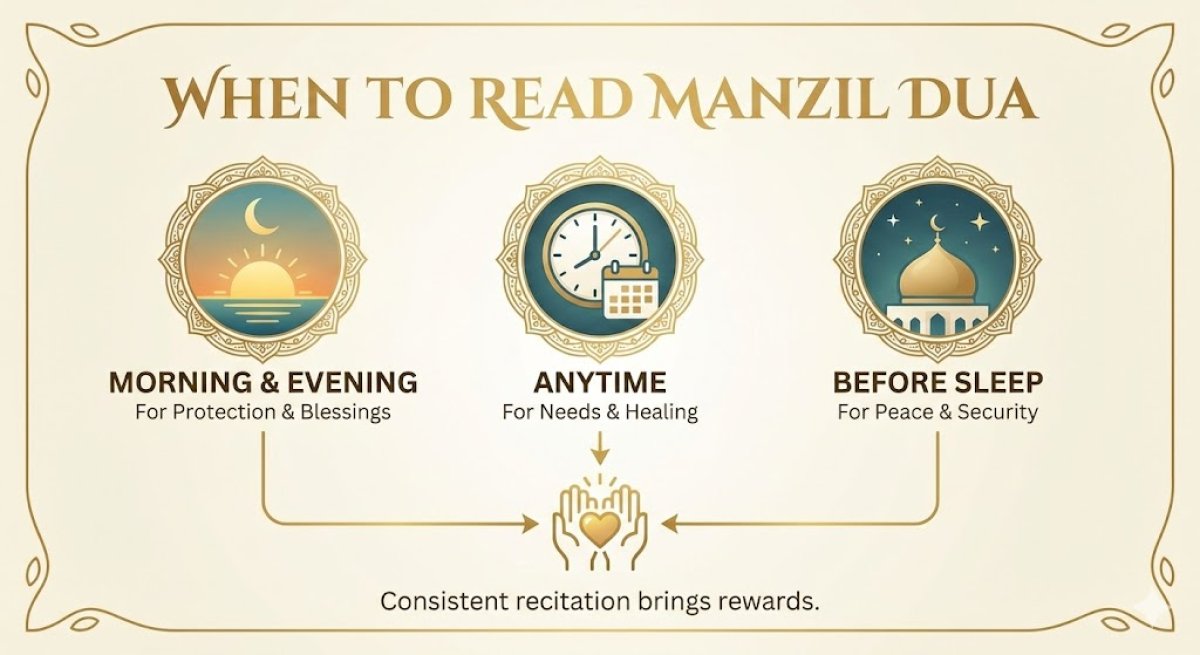
The best and most common time to read Manzil Dua is morning and evening, similar to other protection adhkar.
Read Article →
Manzil Dua consists largely of verses from Al-Baqarah and other protection-focused surahs, it is widely used as ruqyah.
Read Article →