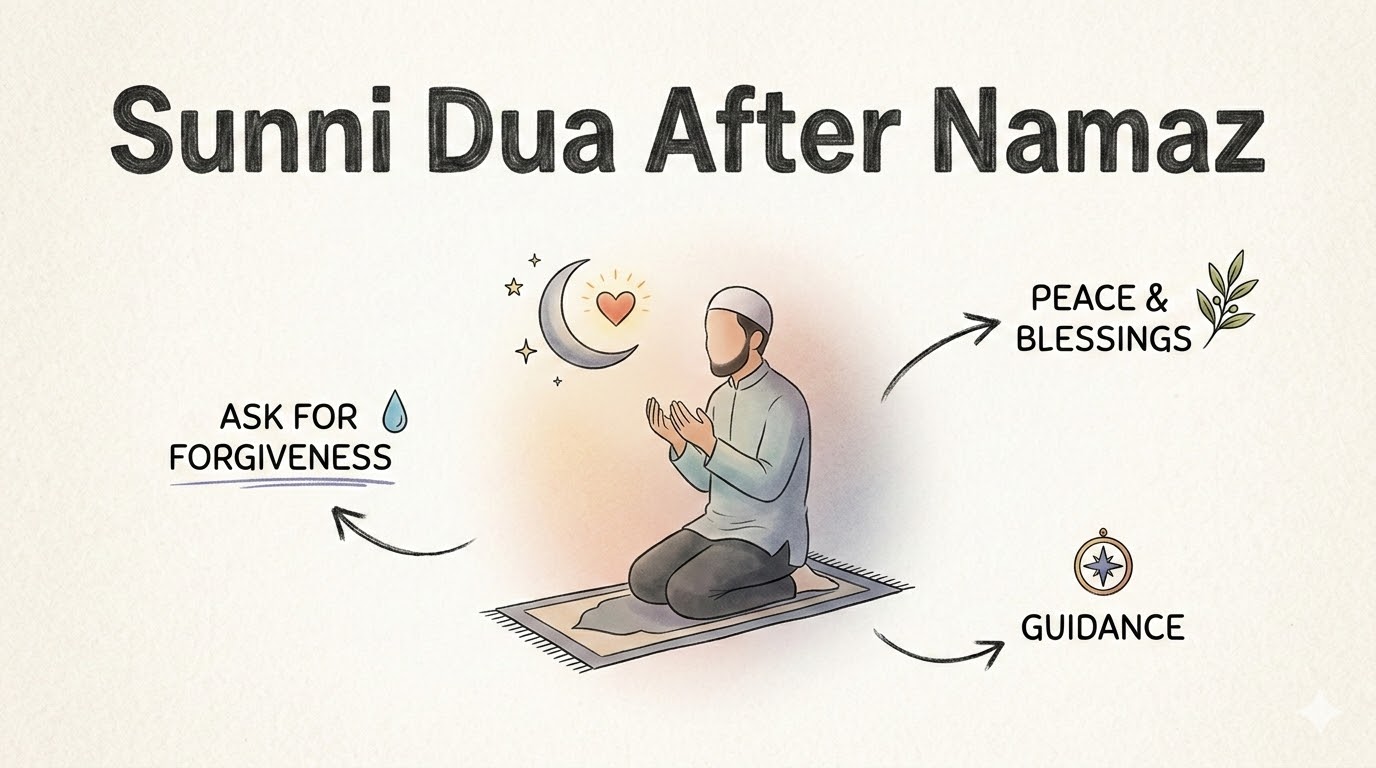
The minutes after fard salah are, in the words of scholars, among the most blessed of the day.
This is not a matter of opinion — it is grounded in numerous authentic hadiths.
The state of a person leaving salah is a particular closeness to Allah, and dua made in that state carries a weight that ordinary moments do not.
Here is the list of Sunni Dua after fard salah:
Astaghfirullah — The First Words After Salaam
أَسْتَغْفِرُ اللهَ ، أَسْتَغْفِرُ اللهَ ، أَسْتَغْفِرُ اللهَ
Translation
I seek forgiveness from Allah. I seek forgiveness from Allah. I seek forgiveness from Allah.
Significance
The very first thing the Prophet ﷺ said after making tasleem was istighfar. This is narrated by Thawban (رضي الله عنه) in Sahih Muslim.
The fact that the Prophet ﷺ said this immediately after completing salah is something worth sitting with. He just prayed. And the first thing he did when the prayer ended was ask for forgiveness.
This tells you something about what salah actually is. It is not a performance after which we dust our hands and say "done." It is an attempt — an imperfect, human attempt — to stand before Allah with full attention. And because it is imperfect, because the mind wandered and the heart was not always present, we seek forgiveness for the gaps. The prayer itself was an act of worship. The istighfar after it is another one — an acknowledgment that even our worship falls short of what He deserves.
Three times. No more, no less. Simple, direct, and from the first moment after salaam.
Allahumma Antas-Salam
اللَّهُمَّ أَنْتَ السَّلَامُ وَمِنْكَ السَّلَامُ، تَبَارَكْتَ يَا ذَا الْجَلَالِ وَالْإِكْرَامِ
Translation
O Allah, You are Peace, and from You comes peace. Blessed are You, O Owner of Majesty and Honor.
Significance
This comes immediately after the three Astaghfirulahs, and it was the practice of the Prophet ﷺ after every salah. Narrated from Aisha (رضي الله عنها) in Sahih Muslim.
The salah itself ends with the word of peace — As-Salamu Alaykum — and this dua extends that peace in the direction it belongs: back toward Allah. You are not just greeting people around you. You are acknowledging where salaam — true peace, the absence of all deficiency — actually lives.
Antas-salam does not simply mean "You are the peaceful One." It means You are Peace itself. Not that You experience peace, but that peace is Your attribute, Your name, Your reality. Everything we experience as peace in this world — in our homes, our hearts, our relationships — is a reflection of one of His names.
Wa minkas-salam — and from You comes peace. No one gives peace except Allah. The world offers noise, busyness, distraction. Genuine stillness of the heart has only one source.
Tabarakta ya dhal-jalali wal-ikram — Blessed are You, O Owner of Majesty and Honor. Al-Jalal refers to Allah's grandeur, His incomparable greatness. Al-Ikram refers to His generosity, His bestowal of honor on His servants. The one who just prayed is leaving the state of standing before the Owner of all majesty and all honor — and this dua reminds them of exactly Who they were just speaking to.
La Ilaha Illallah
لَا إِلَهَ إِلَّا اللهُ وَحْدَهُ لَا شَرِيكَ لَهُ، لَهُ الْمُلْكُ وَلَهُ الْحَمْدُ، يُحْيِي وَيُمِيتُ، وَهُوَ عَلَى كُلِّ شَيْءٍ قَدِيرٌ
Translation
There is no god worthy of worship except Allah, alone, without any partner. To Him belongs the dominion, and to Him belongs all praise. He gives life and causes death, and He has power over all things.
Significance
This is specifically mentioned to be recited ten times after Fajr and Maghrib, in a narration recorded in Sunan al-Tirmidhi.
This is the complete shahada — but expanded. The first part is the declaration of tawheed. The rest is not decoration; each phrase adds something real.
Lahul-mulk — to Him belongs the dominion. Everything you see — government, economy, your health, your family — none of it is ultimately in anyone's hands except His. The most powerful ruler on earth owns nothing in the way Allah owns everything.
Wa lahul-hamd — and to Him belongs all praise. Every sunset, every act of kindness, every moment of relief — points back to Him. He is the origin of all that is praiseworthy.
Yuhyi wa yumit — He gives life and causes death. This is the most certain fact about our existence, and saying it after salah is a reminder of our temporariness. We are not here permanently. We just prayed. And we may not be here for the next prayer. That awareness is not meant to cause fear — it is meant to give weight to the moments we do have.
Al-Mughirah ibn Shu'bah (رضي الله عنه) narrated in Sahih al-Bukhari (6615) that the Prophet ﷺ used to say after prayer: "لَا إِلَهَ إِلَّا اللهُ وَحْدَهُ لَا شَرِيكَ لَهُ، لَهُ الْمُلْكُ وَلَهُ الْحَمْدُ، وَهُوَ عَلَى كُلِّ شَيْءٍ قَدِيرٌ" — and would then add: "the might of the mighty is no benefit against You."
The Tasbeeh
سُبْحَانَ اللهِ — 33
الْحَمْدُ لِلهِ — 33
اللهُ أَكْبَرُ — 33
لَا إِلَهَ إِلَّا اللهُ وَحْدَهُ لَا شَرِيكَ لَهُ، لَهُ الْمُلْكُ وَلَهُ الْحَمْدُ وَهُوَ عَلَى كُلِّ شَيْءٍ قَدِيرٌ
Translation
Subhanallah
Alhamdulillah
Allahu Akbar
There is no god except Allah alone, with no partner. To Him belongs the dominion, and to Him belongs all praise, and He is over all things capable.
Significance
This is perhaps the most widely practiced dhikr after salah, and it comes from one of the most moving stories in the collection of Bukhari and Muslim.
The poor Companions came to the Prophet ﷺ one day, troubled. They said the wealthy Muslims prayed as they prayed and fasted as they fasted — but the wealthy could give charity and free slaves, things the poor could not afford. The Prophet ﷺ told them:
"أَلَا أُخْبِرُكُمْ بِشَيْءٍ إِنْ أَخَذْتُمْ بِهِ أَدْرَكْتُمْ مَنْ سَبَقَكُمْ، وَلَمْ يُدْرِكْكُمْ أَحَدٌ بَعْدَكُمْ، وَكُنْتُمْ خَيْرَ مَنْ أَنْتُمْ بَيْنَ ظَهْرَانَيْهِ إِلَّا مَنْ عَمِلَ مِثْلَهُ: تُسَبِّحُونَ وَتَحْمَدُونَ وَتُكَبِّرُونَ خَلْفَ كُلِّ صَلَاةٍ ثَلَاثًا وَثَلَاثِينَ" (Sahih Bukhari: 843, Sahih Muslim: 595)
SubhanAllah — Glory be to Allah. This word tasbih comes from the root sabaha, which means to swim or to float. When we say SubhanAllah, we are saying: Allah is above and beyond whatever imperfection or limitation the mind might try to attach to Him. He floats free of all that. He is utterly transcendent.
Alhamdulillah — All praise is for Allah. This is tahmid — thanksgiving that recognizes the Source. Not a polite social phrase. A declaration of where all good ultimately comes from.
Allahu Akbar — Allah is the Greatest. Greater than everything — every worry, every fear, every problem, every achievement, every other thing that the heart might be tempted to exaggerate in importance. Whatever feels large in your life right now: Allah is larger.
Imam al-Nawawi (رحمه الله) mentioned that one can recite Allahu Akbar 34 times and then add the final La ilaha illallah — making the total one hundred.
The narration in Sahih Muslim records that whoever does this, their sins will be forgiven even if they were as abundant as the foam of the sea.
Ayat al-Kursi After Every Fard Salah
اللَّهُ لَا إِلَٰهَ إِلَّا هُوَ الْحَيُّ الْقَيُّومُ ۚ لَا تَأْخُذُهُ سِنَةٌ وَلَا نَوْمٌ ۚ لَّهُ مَا فِي السَّمَاوَاتِ وَمَا فِي الْأَرْضِ ۗ مَن ذَا الَّذِي يَشْفَعُ عِندَهُ إِلَّا بِإِذْنِهِ ۚ يَعْلَمُ مَا بَيْنَ أَيْدِيهِمْ وَمَا خَلْفَهُمْ ۖ وَلَا يُحِيطُونَ بِشَيْءٍ مِّنْ عِلْمِهِ إِلَّا بِمَا شَاءَ ۚ وَسِعَ كُرْسِيُّهُ السَّمَاوَاتِ وَالْأَرْضَ ۖ وَلَا يَئُودُهُ حِفْظُهُمَا ۚ وَهُوَ الْعَلِيُّ الْعَظِيمُ
Translation
Allah — there is no deity except Him, the Ever-Living, the Sustainer of existence. Neither drowsiness overtakes Him nor sleep.
To Him belongs whatever is in the heavens and whatever is on the earth. Who is it that can intercede with Him except by His permission?
He knows what is before them and what will be after them, and they encompass not a thing of His knowledge except for what He wills. His Throne extends over the heavens and the earth, and their preservation tires Him not. And He is the Most High, the Most Great.
Significance
The Prophet ﷺ said in a narration transmitted through multiple chains:
"مَنْ قَرَأَ آيَةَ الْكُرْسِيِّ دُبُرَ كُلِّ صَلَاةٍ مَكْتُوبَةٍ لَمْ يَمْنَعْهُ مِنْ دُخُولِ الْجَنَّةِ إِلَّا أَنْ يَمُوتَ" (al-Nasa'i, Ibn Hibban)
"Whoever recites Ayat al-Kursi after every obligatory prayer, nothing will prevent him from entering Paradise except death."
The verse is the greatest verse in the Quran — the Prophet ﷺ said so himself when he asked Ubayy ibn Ka'b which verse was the greatest in the Book of Allah. Every phrase in it is a complete statement about who Allah is. He does not sleep. He does not get tired. He does not forget. He does not need anyone's permission to act. His knowledge encompasses everything that was and everything that will be.
Reading this after salah is an extension of the prayer itself. You just stood before this One. Now you remind yourself, one more time, of exactly Who you stood before. The remembrance anchors what the prayer built.
The Three Quls
قُلْ هُوَ اللَّهُ أَحَدٌ ، اللَّهُ الصَّمَدُ ، لَمْ يَلِدْ وَلَمْ يُولَدْ ، وَلَمْ يَكُن لَّهُ كُفُوًا أَحَدٌ.
قُلْ أَعُوذُ بِرَبِّ الْفَلَقِ ، مِن شَرِّ مَا خَلَقَ ، وَمِن شَرِّ غَاسِقٍ إِذَا وَقَبَ ، وَمِن شَرِّ النَّفَّاثَاتِ فِي الْعُقَدِ ، وَمِن شَرِّ حَاسِدٍ إِذَا حَسَدَ.
قُلْ أَعُوذُ بِرَبِّ النَّاسِ ، مَلِكِ النَّاسِ ، إِلَٰهِ النَّاسِ ، مِن شَرِّ الْوَسْوَاسِ الْخَنَّاسِ ، الَّذِي يُوَسْوِسُ فِي صُدُورِ النَّاسِ ، مِنَ الْجِنَّةِ وَالنَّاسِ.
Translation
1) Say: He is Allah, the One. Allah, the Eternal Refuge. He neither begets nor was born. And there is none comparable to Him.
2) Say: I seek refuge in the Lord of the daybreak — from the evil of what He has created, and from the evil of the darkness when it settles, and from the evil of those who blow on knots, and from the evil of an envier when he envies.
3) Say: I seek refuge in the Lord of mankind, the Sovereign of mankind, the God of mankind — from the evil of the retreating whisperer, who whispers in the breasts of mankind — from among the jinn and mankind.
Significance
The Prophet ﷺ commanded Uqbah ibn Amir (رضي الله عنه) to recite the three Mu'awwidhat — the three Surahs of seeking refuge — after every prayer. The narration is in Sunan Abu Dawud and al-Nasa'i. After Fajr and Maghrib, each is recited three times.
Al-Ikhlas is a complete statement of tawheed. The Prophet ﷺ said it equals a third of the Quran. It covers the essential truth the entire Quran is built around: that Allah is absolutely One, absolutely self-sufficient, and absolutely unlike anything else in existence. Al-Samad — often translated as the Eternal Refuge — means the One to whom all creation turns in its need, while He Himself has no need at all.
Al-Falaq asks for protection from external harms — from darkness, from sihr (the blowing on knots is a reference to black magic), and from envy. These harms are real. Envy is real and it causes real damage in the world. The dua does not pretend otherwise — it names these threats directly and seeks protection from them by name, through the One who created and controls everything that could harm you.
Al-Nas narrows the protection to the deepest and most persistent threat: the whispering directly into the heart. Shaytan does not announce himself. He enters through suggestions that seem reasonable — through distraction, doubt, and delay. This surah seeks refuge from exactly that, invoking Allah by three names at once: Rabb (Sustainer), Malik (King), and Ilah (God) — addressing the full scope of His authority. Reciting these three after every prayer seals the session of worship in a shield of divine protection.
Allahumma A'inni 'ala Dhikrika
اللَّهُمَّ أَعِنِّي عَلَى ذِكْرِكَ، وَشُكْرِكَ، وَحُسْنِ عِبَادَتِكَ
Translation
Allahumma a'inni 'ala dhikrika, wa shukrika, wa husni 'ibadatik
Significance
This dua was taught personally by the Prophet ﷺ to Mu'adh ibn Jabal (رضي الله عنه) and he told him never to leave it after every prayer. It is recorded in Sunan Abu Dawud and authenticated by al-Albani.
This dua does something quiet but profound: it asks Allah for help with the very acts of worship we are supposed to be doing for His sake. It is an acknowledgment that even our dhikr, our gratitude, and our worship are not things we can sustain or perfect on our own. We need His help to remember Him properly. We need His help to be grateful. We need His help to pray the way it should be prayed.
The Prophet ﷺ held Mu'adh's hand when he taught him this. He said: "By Allah, I love you, O Mu'adh" — then gave him this dua and told him to recite it after every prayer. There is tenderness in this narration. It was a personal instruction, given in an act of affection, to one of the greatest scholars among the Companions.
Three things are asked: help with dhikr (remembrance), help with shukr (gratitude), and help with husn al-ibadah (the excellence of worship). These three things, if genuinely received, are essentially the whole of the inner religious life.
Dua for Beneficial Knowledge
اللَّهُمَّ إِنِّي أَسْأَلُكَ عِلْمًا نَافِعًا، وَرِزْقًا طَيِّبًا، وَعَمَلًا مُتَقَبَّلًا
Translation
O Allah, I ask You for knowledge that is beneficial, provision that is good, and deeds that will be accepted.
Significance
Three requests, each with a qualifier that makes it specific and considered.
'Ilman nafi'an — not just any knowledge, but knowledge that is beneficial. There is knowledge that puffs up pride, knowledge that leads nowhere. The dua asks specifically for knowledge that helps — that brings the person closer to Allah and makes them more useful to those around them.
Rizqan tayyiban — not just any sustenance, but tayyib sustenance. Tayyib means pure, wholesome, lawful. A person can earn much through paths that are not clean. The dua asks for provision that arrives through means Allah has approved.
'Amalan mutaqabbalan — deeds that will be accepted. This is perhaps the most sobering part. We do deeds but we cannot guarantee acceptance. That belongs entirely to Allah. The dua acknowledges this and asks for it with sincerity — because an accepted deed, even a small one, is worth more than a large deed done without presence.
Starting the day after Fajr with this dua is a way of orienting the entire day toward what actually matters.
Allahumma Ajirni min an-Nar
اللَّهُمَّ أَجِرْنِي مِنَ النَّارِ
Translation
O Allah, protect me from the Fire.
Significance
Seven times. After Fajr and after Maghrib. Short, direct, unadorned.
The narration mentions that whoever says this seven times after Fajr — if he dies that day — Allah will protect him from the Fire. And whoever says it seven times after Maghrib — if he dies that night — Allah will protect him from the Fire.
There is something profound in the simplicity of this. It is not a long dua. It does not have beautiful literary structure. It is just a person saying to their Lord: protect me from the Fire. And the Prophet ﷺ told us to say it repeatedly, at the two ends of the day, because it contains within it an acknowledgment of the most important thing: that we are not confident of our own goodness, and that we are putting our hope entirely in Allah's mercy.
The scholars say this dua should not become mechanical. Say it seven times but actually think about what you are asking, even once out of the seven. Let the reality of it touch the heart at least briefly.
Allahumma La Mani'a Lima A'tayta
لَا إِلَهَ إِلَّا اللهُ وَحْدَهُ لَا شَرِيكَ لَهُ، لَهُ الْمُلْكُ وَلَهُ الْحَمْدُ وَهُوَ عَلَى كُلِّ شَيْءٍ قَدِيرٌ، اللَّهُمَّ لَا مَانِعَ لِمَا أَعْطَيْتَ، وَلَا مُعْطِيَ لِمَا مَنَعْتَ، وَلَا يَنْفَعُ ذَا الْجَدِّ مِنْكَ الْجَدُّ
Translation
There is no god except Allah alone, with no partner.
To Him belongs the dominion and to Him belongs all praise, and He is over all things capable. O Allah, none can withhold what You give, and none can give what You withhold, and the fortune of the fortunate will not benefit him against You.
Significance
This was recited by the Prophet ﷺ after prayer. Narrated by Al-Mughirah ibn Shu'bah (رضي الله عنه) in Sahih al-Bukhari (6615).
The final line is one of the most grounding statements in all of prophetic dua. Wa la yanfa'u dhal-jaddi minkal-jadd — the wealth, influence, or status of the fortunate cannot protect them against You or benefit them with You.
Al-jadd means worldly fortune — wealth, standing, power. And the sentence says: whatever a person has of worldly authority, it is of no use against Allah's decree. The richest person cannot buy their way out of what Allah has written. The most powerful government cannot override what He has decided. This is not meant to create despair — it is meant to free the heart from being overly impressed by what other people possess, and overly anxious about one's own lack of it.
Standing before Allah five times a day and then closing with this is a complete reset. It puts the world back in its proper size.
Allahumma Inni As'aluka al-Jannah
اللَّهُمَّ إِنِّي أَسْأَلُكَ الْجَنَّةَ، وَأَعُوذُ بِكَ مِنَ النَّارِ
Translation
O Allah, I ask You for Paradise, and I seek refuge in You from the Fire.
Significance
Anas ibn Malik (رضي الله عنه) narrated that the Prophet ﷺ said:
"مَنْ سَأَلَ اللَّهَ الْجَنَّةَ ثَلَاثَ مَرَّاتٍ، قَالَتِ الْجَنَّةُ: اللَّهُمَّ أَدْخِلْهُ الْجَنَّةَ، وَمَنِ اسْتَجَارَ مِنَ النَّارِ ثَلَاثَ مَرَّاتٍ، قَالَتِ النَّارُ: اللَّهُمَّ أَجِرْهُ مِنَ النَّارِ" (Sunan al-Tirmidhi, Sunan Ibn Majah)
"Whoever asks Allah for Paradise three times, Paradise will say: O Allah, admit him to Paradise. And whoever seeks refuge from the Fire three times, the Fire will say: O Allah, protect him from the Fire."
Say it three times. It is one of the most direct things a person can say in dua — no metaphor, no elaborate phrasing, just the two outcomes that matter most in existence, stated plainly and asked for sincerely.
Salawat upon the Prophet ﷺ
اللَّهُمَّ صَلِّ عَلَى مُحَمَّدٍ وَعَلَى آلِ مُحَمَّدٍ، كَمَا صَلَّيْتَ عَلَى إِبْرَاهِيمَ وَعَلَى آلِ إِبْرَاهِيمَ، إِنَّكَ حَمِيدٌ مَجِيدٌ، اللَّهُمَّ بَارِكْ عَلَى مُحَمَّدٍ وَعَلَى آلِ مُحَمَّدٍ، كَمَا بَارَكْتَ عَلَى إِبْرَاهِيمَ وَعَلَى آلِ إِبْرَاهِيمَ، إِنَّكَ حَمِيدٌ مَجِيدٌ
Translation
O Allah, send your blessings upon Muhammad and upon the family of Muhammad, as you sent blessings upon Ibrahim and the family of Ibrahim. Indeed, You are the Most Praiseworthy, the Most Glorious. O Allah, bless Muhammad and the family of Muhammad, as You blessed Ibrahim and the family of Ibrahim. Indeed, You are the Most Praiseworthy, the Most Glorious.
Significance
Many scholars consider sending salawat upon the Prophet ﷺ after the dhikr of salah to be among the most recommended acts, based on the Quranic command in Surah Al-Ahzab and the authentic hadiths about its reward.
The Prophet ﷺ said in a hadith narrated by Abdullah ibn Mas'ud (رضي الله عنه) recorded by al-Tirmidhi:
"أَوْلَى النَّاسِ بِي يَوْمَ الْقِيَامَةِ أَكْثَرُهُمْ عَلَيَّ صَلَاةً"
"The closest of people to me on the Day of Resurrection will be those who sent the most salawat upon me."
Salawat is not just a formal closing. It is an expression of love, gratitude, and connection to the one through whom the entire religion reached us. Every dua we just made, every dhikr we recited — we learned it because of the Prophet ﷺ. Closing the post-salah session by invoking blessings upon him is a natural and sincere acknowledgment of that.
A Practical Summary
After every fard salah: Astaghfirullah × 3 → Allahumma antas-salam → SubhanAllah 33 × Alhamdulillah 33 × Allahu Akbar 34 + completing La ilaha illallah → Ayat al-Kursi → Surah Al-Ikhlas, Al-Falaq, Al-Nas (once each) → Allahumma a'inni 'ala dhikrika → Personal dua
After Fajr specifically, add: Allahumma inni as'aluka 'ilman nafi'an → Allahumma ajirni minan-nar × 7 → Allahumma inni as'alukal-jannah × 3
After Maghrib, add: La ilaha illallahu wahdahu × 10 → Allahumma ajirni minan-nar × 7
After Fajr and Maghrib: Surah Al-Ikhlas, Al-Falaq, Al-Nas × 3 each (instead of once)
On Making Your Own Dua
After all the masnoon adhkar are complete, the doors are open for personal dua — asking Allah in whatever words you have, in Arabic or your own language, for whatever is on your heart.
The Prophet ﷺ was asked which time dua is most likely to be accepted.
He said — as recorded in Sunan al-Tirmidhi:
"جَوْفُ اللَّيْلِ الْآخِرُ وَدُبُرَ الصَّلَوَاتِ الْمَكْتُوبَاتِ"
"The depths of the last part of the night, and at the end of the obligatory prayers."
So after completing everything above, do not rush away.
Sit for a moment.
Think about what you need. Think about who among your family and community needs your dua. And ask. There are no required words for this part — only sincerity.
So, start with one dua. Learn it properly, understand what you are saying, and say it with attention.
Then add the next.
That is how it works. Not all at once, but steadily — and with sincerity.
