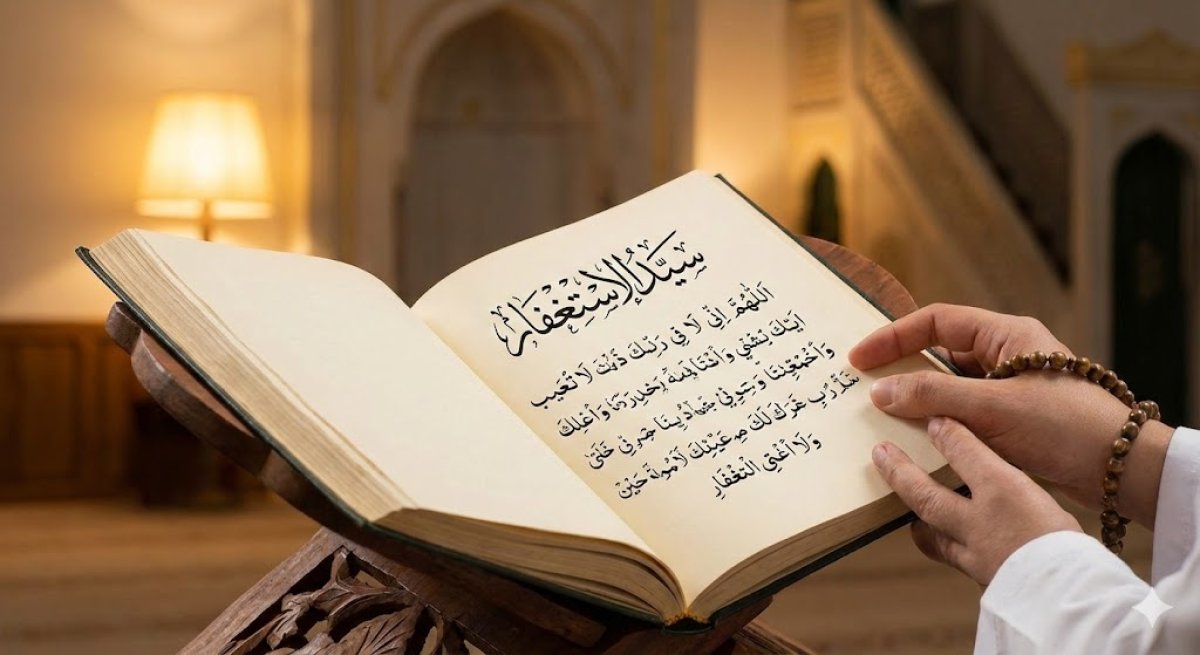
Sayyidul Istighfar is the most complete and powerful way to ask Allah for forgiveness.
The Prophet Muhammad (peace be upon him) taught this Dua to his companions because it covers everything a believer needs to say to fix their relationship with Allah.
The Full Arabic Version
Sayyidul Istighfar
اللَّهُمَّ أَنْتَ رَبِّي لاَ إِلَهَ إِلاَّ أَنْتَ خَلَقْتَنِي وَأَنَا عَبْدُكَ وَأَنَا عَلَى عَهْدِكَ وَوَعْدِكَ مَا اسْتَطَعْتُ أَعُوذُ بِكَ مِنْ شَرِّ مَا صَنَعْتُ أَبُوءُ لَكَ بِنِعْمَتِكَ عَلَيَّ وَأَبُوءُ لَكَ بِذَنْبِي فَاغْفِرْ لِي فَإِنَّهُ لاَ يَغْفِرُ الذُّنُوبَ إِلاَّ أَنْتَ
Translation
O Allah, You are my Lord. There is no god worthy of worship except You. You created me, and I am Your servant. And I uphold Your covenant and promise to the best of my ability. I seek refuge in You from the evil of what I have done. I acknowledge Your blessings upon me, and I acknowledge my sin. So forgive me — for indeed, none forgives sins except You.
Significance
The meaning of this Dua is very deep, which is why it is called the "Master" of Istighfar.
When you recite this, you start by saying, "O Allah, You are my Lord, there is no God but You." This is a renewal of your faith (Iman). You are reminding yourself that Allah is the only one in charge.
Then you say, "You created me and I am Your slave." This shows humility. You are admitting that you have no power without Him.
The next part is a promise: "I am faithful to Your covenant and my promise to You as much as I can."
You are telling Allah that you are trying your best to obey Him, even though you are not perfect. You then say, "I seek refuge in You from the evil of what I have done."
Here, you admit that your sins are harmful and you need Allah's protection from the bad consequences of your own mistakes.
Finally, you end with gratitude and honesty: "I acknowledge Your favors upon me, and I admit my sin."
You are balancing two things—thanking Allah for all the good He gave you, while admitting the bad you did in return.
You close by asking, "So forgive me, for indeed, no one forgives sins except You." This confirms that only Allah has the authority to wipe away your mistakes.
Word-by-Word Explanation
1) اللَّهُمَّ — Allahumma
"O Allah."
This is the opening address — the calling out to Allah directly, with the force and urgency that this form in Arabic carries.
Every dua that begins with Allahumma is a personal appeal, not a general recitation. You are speaking to Someone.
That awareness should be present from this very first word.
2) أَنْتَ رَبِّي — Anta Rabbi
"You are my Lord."
The dua begins not with the sin — not with the request — but with an affirmation of who Allah is in relation to the one speaking.
Rabb carries layers of meaning: Lord, Sustainer, the One who nurtures and brings to completion. Saying Anta Rabbi is a declaration of belonging. You belong to Him.
He is responsible for you. And you know it.
Before anything else is said, this is established.
3) لَا إِلَهَ إِلَّا أَنْتَ — La ilaha illa Anta
"There is no god worthy of worship except You."
This is the shahada — the same words that enter a person into Islam, that are whispered into a newborn's ear, and that a Muslim hopes will be on their tongue at death.
Placing it inside a dua for forgiveness is not coincidental.
It is the foundation. Before any sin can be confessed, the one confessing must reaffirm who they are confessing to. There is no one else. Only You.
4) خَلَقْتَنِي وَأَنَا عَبْدُكَ — Khalaqtani wa ana 'abduka
"You created me, and I am Your servant."
Two realities, side by side.
He created me — so my existence is entirely from Him, not something I produced or earned myself. And I am His 'abd — His servant.
The word 'abd in Arabic does not carry the degraded meaning that "slave" does in English. In Islamic usage, being Allah's 'abd is a station of honor.
The Prophet ﷺ himself is referred to in the Quran as 'abduhu — His servant — and that is not diminishment; it is a description of the highest proximity.
Saying these words is an act of honesty.
I did not create myself. I do not own myself. I am here because You put me here.
5) وَأَنَا عَلَى عَهْدِكَ وَوَعْدِكَ مَا اسْتَطَعْتُ — Wa ana 'ala 'ahdika wa wa'dika mastata'tu
"And I uphold Your covenant and promise to the best of my ability."
This phrase has two parts.
The 'ahd — the covenant — refers to the primordial agreement. In the Quran, Allah reminds humanity that before they were born into this world, they testified to His lordship.
That is the covenant we carry without consciously remembering it, but that our fitrah — our innate nature — retains.
The wa'd — the promise — refers to what the believer commits to in this life: to worship Allah, to remain on the straight path.
And then: mastata'tu — to the best of my ability. This is the honest clause. Not "I have fulfilled it perfectly." The person reciting this dua knows they have not been perfect.
But they are saying: I am trying. I have not abandoned it. I am still here, standing before You, attempting to honor what was asked of me.
This phrase is what makes the dua human. It does not pretend.
6) أَعُوذُ بِكَ مِنْ شَرِّ مَا صَنَعْتُ — A'udhu bika min sharri ma sana'tu
"I seek refuge in You from the evil of what I have done."
A'udhu bika — I seek Your protection. The same opening as the ta'awwudh before Quran recitation.
The one reciting acknowledges that their own actions carry harm — not just to others, but to themselves. Sins have consequences.
They leave marks. They open doors to further harm.
And rather than face those consequences alone, the believer runs toward Allah, asking Him to be a shield between them and the damage their own choices may have invited.
This is a deeply honest line.
It does not blame circumstances or other people. It says: what I have done — ma sana'tu — carries a dark side, and I need You to protect me from it.
7) أَبُوءُ لَكَ بِنِعْمَتِكَ عَلَيَّ — Abu'u laka bini'matika 'alayya
"I acknowledge Your blessings upon me."
Abu'u is from bawa'a — to acknowledge, to confess fully, to return something to where it belongs.
Ni'ma — blessing, favor. 'Alayya — upon me, specifically. This is not a general acknowledgment that Allah blesses people. It is personal: the blessings You placed in my life, through my body, through my family, through every provision I have received — I see them.
I admit they came from You.
The scholars note that acknowledging blessings before confessing sins is a method of humbling the self.
You remember what you were given, and then you realize the full weight of what you did in spite of it.
8) وَأَبُوءُ لَكَ بِذَنْبِي — Wa abu'u laka bidhanbi
"And I acknowledge my sin."
The same word — abu'u — but now turned toward the sin.
This is the confession. It comes after the acknowledgment of blessings, not before it, which is significant.
The structure of the dua itself prepares the person: first know who Allah is, then acknowledge what He gave you, and only then admit what you have done.
By the time you reach this phrase, the heart has been brought into the right posture.
Dhanb — sin, fault. It is singular in the Arabic but understood to encompass all sins.
The person stands before Allah and says simply: I know what I have done.
9) فَاغْفِرْ لِي — Faghfir li
"So forgive me."
After everything — the affirmation of Allah's lordship, the declaration of faith, the acknowledgment of being His servant, the admission of trying and falling short, the seeking of refuge, the recognition of blessings, the confession of sin — now comes the request. Just three words.
Fa — so, therefore, in light of all this. Ighfir — forgive, cover, shield. Li — me.
The structure of the dua means this request does not arrive emptily. It arrives carried on the weight of everything before it.
10) فَإِنَّهُ لَا يَغْفِرُ الذُّنُوبَ إِلَّا أَنْتَ — Fa innahu la yaghfirudh-dhunuba illa Anta
"For indeed, none forgives sins except You."
The closing of the dua is a theological statement and a complete closing of the door to everything else.
No ritual can erase sins on its own. No person can forgive on Allah's behalf.
Only Allah forgives.
This line is both a declaration and a reason for the request: I am asking You, and only You, because there is nowhere else this request can rightfully go.
The dua begins with Anta — You — and it ends with Anta — You.
Everything in between is framed by the acknowledgment of who Allah is. That is not an accident.
Who Narrated This Dua, and From Where Does It Come?
The hadith comes from Shaddad ibn Aws رضي الله عنه, a companion of the Prophet ﷺ known for his knowledge and his deep attachment to worship.
It is recorded in Sahih al-Bukhari — the most rigorously authenticated collection of hadith in Islamic scholarship.
The hadith reads:
قَالَ النَّبِيُّ صلى الله عليه وسلم: سَيِّدُ الاِسْتِغْفَارِ أَنْ يَقُولَ الْعَبْدُ: اللَّهُمَّ أَنْتَ رَبِّي، لاَ إِلَهَ إِلاَّ أَنْتَ، خَلَقْتَنِي وَأَنَا عَبْدُكَ، وَأَنَا عَلَى عَهْدِكَ وَوَعْدِكَ مَا اسْتَطَعْتُ، أَعُوذُ بِكَ مِنْ شَرِّ مَا صَنَعْتُ، أَبُوءُ لَكَ بِنِعْمَتِكَ عَلَيَّ، وَأَبُوءُ لَكَ بِذَنْبِي فَاغْفِرْ لِي، فَإِنَّهُ لاَ يَغْفِرُ الذُّنُوبَ إِلاَّ أَنْتَ
(Sahih al-Bukhari, 6306)
The Prophet ﷺ then added that whoever recites it during the day with firm conviction and dies before evening will be from the people of Jannah.
And whoever recites it at night with firm conviction and dies before morning will be from the people of Jannah.
That is a remarkable statement.
Not for the dying part — most of us will not die immediately after reciting it.
But because of what it implies about the weight of sincerity.
The one who recites it with yaqeen — with genuine certainty — is in a state that, if it were their last moment, would be sufficient.
But why This Dua Is Called "Sayyid" — Master
The word sayyid was chosen by the Prophet ﷺ deliberately, and the scholars have reflected on why.
As we discussed above, this dua contains all the essential elements of complete repentance — acknowledgment of Allah's lordship, renewal of the covenant of servitude, admission of sin without deflection, recognition of blessings, and the request for forgiveness directed exclusively to the only One who can grant it.
Other forms of istighfar may contain one or two of these elements. This one contains them all.
It is also complete because it does not leave the person passive. The phrase mastata'tu — to the best of my ability — is a commitment to continued effort.
You are not just asking to be forgiven for the past. You are affirming, in the same breath, that you are still trying.
When and How to Recite It
The hadith specifically mentions morning and evening, which is why Sayyidul Istighfar is included in the collections of evening and morning adhkar.
Most scholars recommend reciting it at least once after Fajr and once in the evening before sleeping.
But that is a minimum, not a ceiling.
There is nothing preventing a person from reciting it at other times — after a sin, in moments of regret, during times of difficulty.
The Prophet ﷺ himself sought forgiveness more than seventy times each day, and he was guaranteed forgiveness.
If someone with no sin sought forgiveness that often, what does that say about what the rest of us should be doing?
The condition mentioned in the hadith is moqinan biha — reciting it with firm conviction, with genuine faith in its meaning.
Istighfar and the Heart
There is a hadith in Sunan Ibn Majah that describes what happens when a believer commits a sin: a black spot forms on the heart. If they repent and seek forgiveness, the heart is polished clean.
If the sin increases, the black spot grows.
The Quran refers to this in Surah Al-Mutaffifin: Kalla bal rana 'ala quloobihim — rather, what they used to earn has covered their hearts. Ran — a covering, a rust, a layer over something that was once bright.
Istighfar, at its core, is the act of polishing.
Not only are you asking Allah to forgive the sin in terms of its consequence in the next life — you are also, through genuine repentance, beginning to restore something in yourself.
The heart that was becoming coated starts to clear. Not perfectly, not immediately. But it begins.
This is why the scholars say that a person who sins and then makes sincere tawbah may end up in a better state than if they had never sinned at all — because repentance awakens something in the heart that complacency never would.
Reciting Without Ceasing the Sin
The scholars are consistent on this point: istighfar without genuine intention to stop the sin is a contradiction.
It is not that such a recitation has no value — but the sayyid of istighfar deserves to be treated as such. It deserves honesty.
If a person recites Sayyidul Istighfar each morning while actively continuing in a sin they have no intention of leaving, the words are not landing where they should.
The phrase a'udhu bika min sharri ma sana'tu — I seek refuge from the evil of what I have done — should carry at minimum a genuine wish to be different.
That said, do not let this discourage you from reciting it even in states of weakness.
Sometimes a person begins reciting in a state of contradiction and, over time, the words begin to work on them.
The very act of returning to these words each morning keeps the door of awareness open.
And when the door is open, mercy can enter.
So How Can You Memorize It?
The dua is four lines if written out clearly.
People who did not grow up reciting it often find it easier to learn in three sections: the opening affirmations (Anta Rabbi through mastata'tu), the seeking of refuge and acknowledgment (a'udhu through bidhanbi), and the final request (faghfir li through illa Anta).
Writing it by hand helps.
Reading the Arabic alongside the translation, slowly and with attention to meaning, helps even more — because when you know what each phrase means, the words stay.
