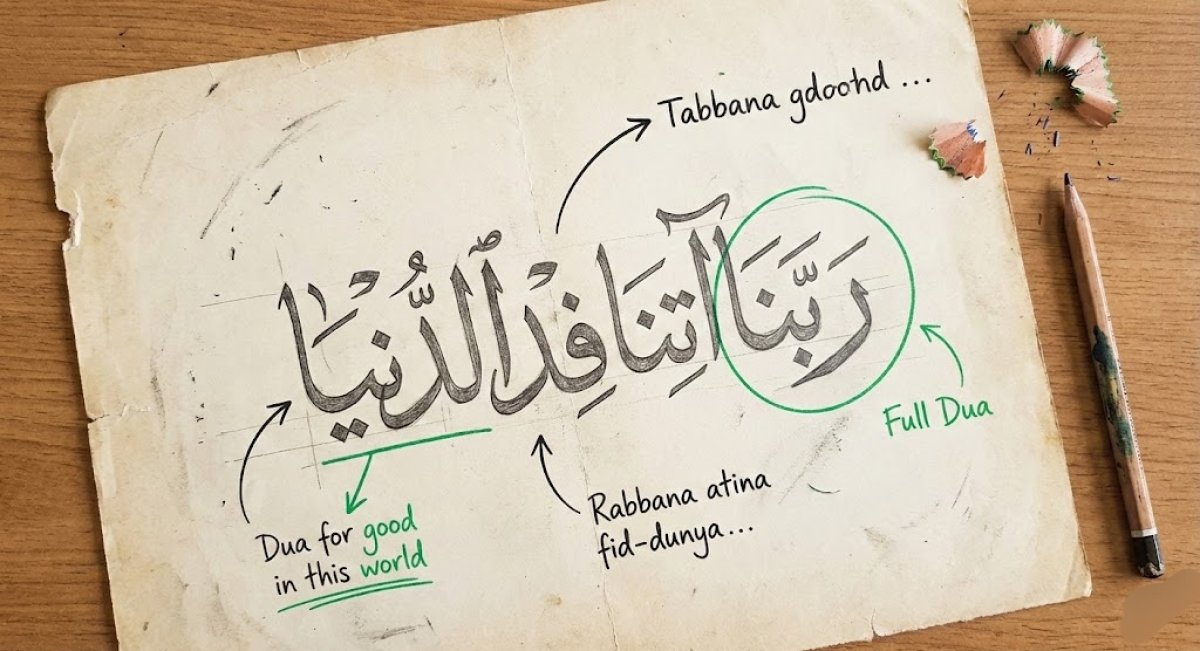
The dua "Rabbana Atina Fid Dunya" is one of the most beautiful and complete dua a person can make to Allah.
It is often called the "comprehensive dua" because it does not just ask for one thing; it asks for everything good in this life and the life that comes after death.
This prayer teaches us that it is okay to ask Allah for a happy life today while also making sure we are preparing for our meeting with Him in the future.
Full Dua With Arabic Transliteration and Explanation
رَبَّنَا آتِنَا فِي الدُّنْيَا حَسَنَةً وَفِي الْآخِرَةِ حَسَنَةً وَقِنَا عَذَابَ النَّارِ
Translation
Rabbana atina fid-dunya hasanatan wa fil-akhirati hasanatan waqina 'adhaban-nar.
Significance
This dua is divided into three very important requests that cover every part of a believer's existence.
First, we say "Our Lord, give us in this world that which is good." When we ask for "good" (hasanah) in this world, we are asking Allah for things that make life peaceful and helpful for our faith. This includes having enough food, a safe home, a loving family, good health, and knowledge that helps us grow. It is a request for a life that is comfortable and free from heavy burdens.
Second, we ask for "good in the Hereafter." This is the most important part because the life after death lasts forever. Here, we are asking Allah for His mercy on the Day of Judgment, the shade of His throne, and the highest place in Paradise (Jannah). By asking for good in both worlds, we show that a believer wants to succeed both now and later.
Finally, we say "and protect us from the punishment of the Fire." This is a humble plea for safety. We admit that we are human and make mistakes, so we ask Allah to forgive us and keep us far away from anything that would lead us to the Hellfire. It is a prayer for ultimate safety and peace.
When to Recite This Dua
Because this dua is so short and powerful, you can recite it at any time of the day or night.
However, there are specific times when it is extra special to say it.
Many people recite it during their daily prayers (Salah) after the Tashahhud and before saying the final Taslim.
It is also very common to recite this dua while performing Tawaf around the Ka'bah, specifically between the Yemeni Corner (Rukn al-Yamani) and the Black Stone (Hajar al-Aswad).
It is a perfect dua to say after finishing a meal, when traveling, or whenever you feel you need the help of Allah.
Qur’an Reference
This dua is found in the Holy Qur’an in Surah Al-Baqarah, Ayah 201:
وَمِنْهُم مَّن يَقُولُ رَبَّنَا آتِنَا فِي الدُّنْيَا حَسَنَةً وَفِي الْآخِرَةِ حَسَنَةً وَقِنَا عَذَابَ النَّارِ
There is also a Sahih Hadith in Sahih Muslim (Hadith: 2690) which mentions that this was the most frequent dua made by the Prophet Muhammad (peace be upon him):
عَنْ أَنَسٍ، قَالَ كَانَ أَكْثَرُ دَعْوَةِ النَّبِيِّ صلى الله عليه وسلم " اللَّهُمَّ آتِنَا فِي الدُّنْيَا حَسَنَةً وَفِي الآخِرَةِ حَسَنَةً وَقِنَا عَذَابَ النَّارِ "
