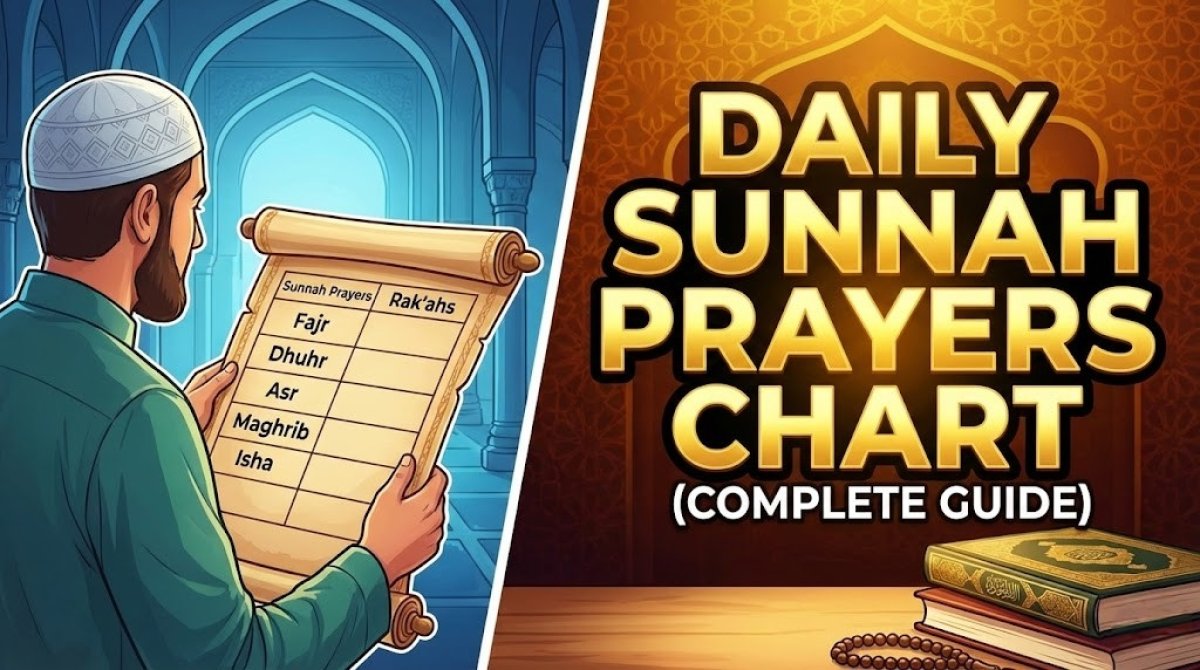
There is a narration that should stop every Muslim in their tracks.
عَنْ أُمِّ حَبِيبَةَ رَضِيَ اللَّهُ عَنْهَا قَالَتْ: سَمِعْتُ رَسُولَ اللَّهِ ﷺ يَقُولُ:
مَا مِنْ عَبْدٍ مُسْلِمٍ يُصَلِّي لِلَّهِ كُلَّ يَوْمٍ ثِنْتَيْ عَشْرَ رَكْعَةً تَطَوُّعًا، غَيْرَ الْفَرِيضَةِ، إِلَّا بَنَى اللَّهُ لَهُ بَيْتًا فِي الْجَنَّةِ.
"Whoever prays twelve rak'ahs of Sunnah during the day and night, Allah will build for him a house in Paradise." (Sahih Muslim)
Twelve rak'ahs. A house in Jannah.
Most Muslims have heard this hadith. Far fewer know exactly which twelve rak'ahs are being referred to, when to pray them, and how to protect them even on the busiest days.
That is what this guide is for.
By the end, you will have a complete Sunnah prayers chart memorised in your mind, not just saved on your phone — and a realistic plan to make it a permanent part of your day.
Before the Chart: Understanding What Sunnah Prayers Actually Are
The word Sunnah in the context of prayer means a prayer that the Prophet ﷺ performed voluntarily, beyond what Allah made obligatory.
They are not sinful to miss.
But the scholars say: the one who abandons them habitually has done themselves a great injustice.
Sunnah prayers fall into two distinct categories, and understanding the difference changes how you approach them entirely.
Sunnah Mu'akkadah — The Emphasised Prayers
These are the prayers the Prophet ﷺ almost never abandoned.
He prayed them at home, while travelling, in times of ease and difficulty.
The scholars of all four major madhabs agree: leaving these consistently is blameworthy, even if not sinful. These are the twelve rak'ahs of the hadith above.
Sunnah Ghair Mu'akkadah — The Recommended Prayers
These are prayers the Prophet ﷺ sometimes performed and sometimes did not.
Missing them carries no blame whatsoever.
They are bonus worship — flexible, optional, and deeply rewarded when performed. The 4 rak'ahs before Asr and the extra 2 after Isha belong here.
A critical point many Muslims get wrong: when life gets hard, do not abandon all Sunnah prayers. That is an all-or-nothing thinking trap.
The correct approach is to always protect the Mu'akkadah, and let the Ghair Mu'akkadah flex with your circumstances.
The Complete Daily Sunnah Prayers Chart
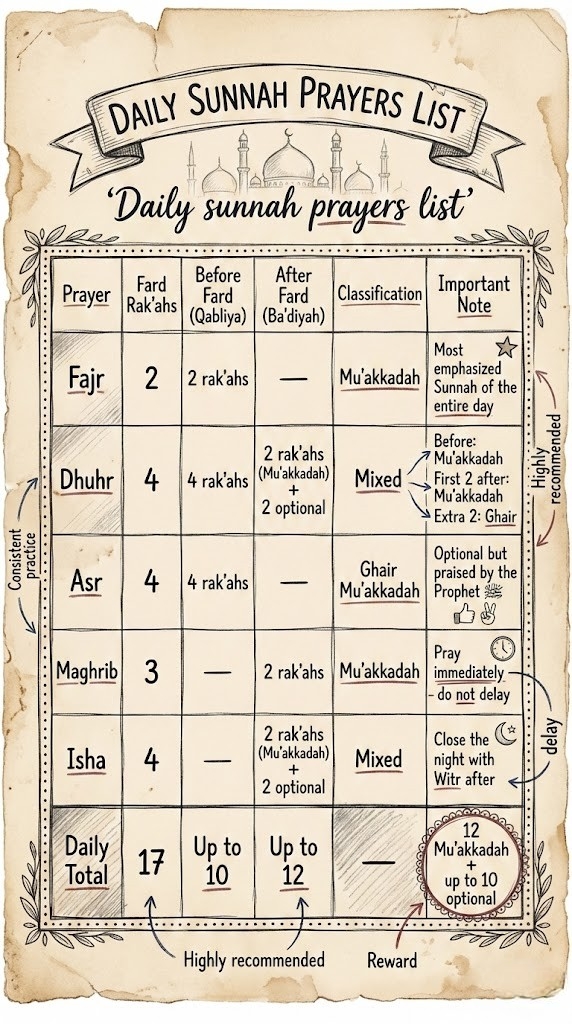
Below is the full chart covering every prayer, every Sunnah rak'ah before and after Fard, and the classification of each:
| Prayer |
Fard Rak'ahs |
Before Fard (Qabliya) |
After Fard (Ba'diyah) |
Classification |
Important Note |
| Fajr |
2 |
2 rak'ahs |
— |
Mu'akkadah |
Most emphasized Sunnah of the entire day |
| Dhuhr |
4 |
4 rak'ahs |
2 rak'ahs (Mu'akkadah) + 2 optional |
Mixed |
Before: Mu'akkadah. First 2 after: Mu'akkadah. Extra 2: Ghair |
| Asr |
4 |
4 rak'ahs |
— |
Ghair Mu'akkadah |
Optional but praised by the Prophet ﷺ |
| Maghrib |
3 |
— |
2 rak'ahs |
Mu'akkadah |
Pray immediately — do not delay |
| Isha |
4 |
— |
2 rak'ahs (Mu'akkadah) + 2 optional |
Mixed |
Close the night with Witr after |
| Daily Total |
17 |
Up to 10 |
Up to 12 |
— |
12 Mu'akkadah + up to 10 optional |
Reading the chart: The green-coded prayers (Fajr before, Dhuhr before and first 2 after, Maghrib after, Isha first 2 after) are your twelve Mu'akkadah rak'ahs.
Everything else is bonus.
The Exact 12 Rak'ahs That Build a House in Jannah
Let us be precise.
Here are the twelve rak'ahs — named, numbered, and timed:
| # |
Prayer |
Rak'ahs |
When |
| 1–2 |
Fajr |
2 rak'ahs |
Before Fard |
| 3–6 |
Dhuhr |
4 rak'ahs |
Before Fard |
| 7–8 |
Dhuhr |
2 rak'ahs |
After Fard |
| 9–10 |
Maghrib |
2 rak'ahs |
After Fard |
| 11–12 |
Isha |
2 rak'ahs |
After Fard |
| Total |
|
12 rak'ahs |
= A house in Jannah |
Notice what is absent from this list: Asr.
There is no Mu'akkadah Sunnah for Asr.
And notice that Dhuhr carries the heaviest Sunnah load of any prayer — six Mu'akkadah rak'ahs spread before and after.
Fajr: The Sunnah You Should Never Trade for Ten More Minutes of Sleep
The Prophet ﷺ said: "The two rak'ahs before Fajr are better than the world and everything in it." (Sahih Muslim)
Read that again slowly.
Better than the world and everything in it. Every house, every fortune, every experience this life contains — all of it, outweighed by two rak'ahs before Fajr.
This is the single most protected Sunnah in Islamic practice. The Prophet ﷺ would pray these even while travelling, which he did not do for many other Sunnah prayers. If you commit to only one Sunnah prayer for the rest of your life, it should be this one.
Timing: Before Fajr Fard only. The window opens at the time of Fajr adhan and closes when the Fard prayer begins.
If you miss it: This is one of the rare cases where a missed Sunnah can be made up. If you miss the Fajr Sunnah, pray it after sunrise. The evidence for this comes from the Prophet ﷺ himself, who made it up in this way.
How to pray it: Two rak'ahs, kept short. The Prophet ﷺ would recite Surah Al-Kafirun in the first rak'ah and Surah Al-Ikhlas in the second.
These short surahs are not compulsory, but following this practice is a beautiful way to honour his example.
Dhuhr: The Most Rewarding Sunnah Block of the Day
Dhuhr is where the serious worshipper earns the most.
Six Mu'akkadah rak'ahs in one prayer window — four before and two after — plus the option to add two more Ghair Mu'akkadah, giving you up to ten rak'ahs of voluntary prayer at Dhuhr alone.
4 Rak'ahs Before Dhuhr Fard (Mu'akkadah)
Pray these before the congregation begins.
You may pray them as one set of four, or split them into two sets of two with a salaam in between — both are valid according to the majority of scholars.
The Prophet ﷺ said: "Whoever is consistent upon four rak'ahs before Dhuhr and four after it, Allah will forbid the Fire from touching him." (Abu Dawud, Tirmidhi)
2 Rak'ahs After Dhuhr Fard (Mu'akkadah)
These are part of your twelve.
Pray them immediately after the congregation ends, before moving from your spot if possible.
Do not let conversation pull you away.
2 Additional Rak'ahs After Dhuhr (Ghair Mu'akkadah)
Optional.
Pray these when you have the time and energy. They are the extra layer, not the foundation.
Asr: The Neglected Sunnah With a Stunning Du'a Attached to It
There is no Mu'akkadah Sunnah for Asr.
But the Prophet ﷺ made a remarkable invocation about those who pray the optional four rak'ahs before it:
"May Allah have mercy on the one who prays four rak'ahs before Asr prayer." (Abu Dawud, Tirmidhi — authenticated by Al-Albani)
A direct mercy supplication from the Prophet ﷺ for four optional rak'ahs.
Important: once the Asr Fard has been prayed, do not pray any voluntary Sunnah after it.
The time between Asr and Maghrib is one of the two prohibited times for voluntary prayer.
Maghrib: Short Window, Enormous Reward
Maghrib has a narrow window — narrower than any other prayer. The sunnah after Maghrib is two rak'ahs, and the scholars emphasise praying them in the same spot, immediately after the Fard, before any conversation or movement.
The Prophet ﷺ was described as rushing to pray his Maghrib Sunnah to the point that his companions said he could barely be reached between the Fard and the Sunnah.
If you are praying in congregation at the masjid, stay in your row or move slightly aside and pray your two rak'ahs immediately.
Do not wait for the rows to clear.
Do not stop to greet people. Protect this Sunnah first, then socialise.
Isha: Close the Night with Order and Intention
After Isha Fard, pray two Mu'akkadah rak'ahs.
Then, if you have the energy, add two more Ghair Mu'akkadah. Then close the night with Witr.
This sequence matters.
Many people pray Isha Fard, then immediately go to Witr, skipping the Sunnah rak'ahs entirely. This is a significant loss.
The correct order: Isha Fard → 2 Mu'akkadah Sunnah → 2 optional Sunnah → Witr.
Witr: The Seal That Completes the Night
Witr is not one of the twelve Mu'akkadah rak'ahs discussed above, but it deserves its own section because abandoning it is treated with near-obligatory severity by the Hanafi school and as a very strong Sunnah by the others.
The Prophet ﷺ said: "Make Witr the last of your prayers at night." (Bukhari)
He never abandoned it. Not once.
So How many rak'ahs?
Minimum one, commonly three, and up to eleven. Praying three rak'ahs with one salaam or two sets (2+1) are both acceptable. The key is consistency in number, night after night.
When to pray it: Ideally as the very last prayer before sleep.
But If you regularly wake for Tahajjud, delay Witr until after your night prayer.
If you do not, pray it before you sleep so you do not miss it.
But what If you miss it?
Well, unlike most Sunnah prayers, Witr can be made up after Fajr as a shaf' (even number) prayer, though the majority say this is done as two rak'ahs rather than one to avoid praying an odd number during the prohibited time.
Your Complete Daily Sunnah Prayer Schedule
Here is what a complete day of Sunnah prayer looks like in practice:
Fajr: → Wake up. Pray 2 rak'ahs Sunnah Mu'akkadah. → Pray 2 rak'ahs Fard. → Recite morning adhkar.
Dhuhr: → Pray 4 rak'ahs Sunnah Mu'akkadah (can split as 2+2). → Pray 4 rak'ahs Fard. → Pray 2 rak'ahs Sunnah Mu'akkadah. → Pray 2 rak'ahs optional (Ghair Mu'akkadah) if able.
Asr: → Pray 4 rak'ahs optional Sunnah (Ghair Mu'akkadah) before Fard. → Pray 4 rak'ahs Fard. → No Sunnah after Asr.
Maghrib: → Pray 3 rak'ahs Fard. → Immediately pray 2 rak'ahs Sunnah Mu'akkadah. → Recite evening adhkar.
Isha: → Pray 4 rak'ahs Fard. → Pray 2 rak'ahs Sunnah Mu'akkadah. → Pray 2 rak'ahs optional (Ghair Mu'akkadah) if able. → Pray Witr (minimum 1 rak'ah, commonly 3).
Daily minimum (12 Mu'akkadah + Witr): 13-15 rak'ahs of voluntary prayer. Daily maximum (all Sunnah + optional + Witr): Up to 24 voluntary rak'ahs.
The 5 Timing Rules That Protect Your Sunnah Prayers
Knowing when the window opens and closes prevents you from praying in the wrong time and wasting the effort.
Rule 1 — Fajr Sunnah cannot be prayed after sunrise (in general). The exception is the makeup ruling mentioned above. During the Fajr window, it must come before the Fard, not after.
Rule 2 — Dhuhr Sunnah before Fard has a flexible split. You may pray 4 rak'ahs as one set or as 2+2. Both are established.
Rule 3 — Ba'diyah prayers should be prayed immediately. The scholars emphasise praying the after-Fard Sunnah in the same spot, without delay. The spiritual momentum of the Fard prayer carries directly into the Sunnah.
Rule 4 — No voluntary prayer after Asr Fard. This is one of the prohibited prayer times. The exception applies only to prayers with a specific cause, such as greeting the masjid (tahiyyatul masjid) according to some scholars.
Rule 5 — Witr must come after Isha Fard. Praying Witr before Isha Fard is not valid. And it must be the last voluntary prayer of the night — after Witr, no more Nafl until Fajr, unless waking for Tahajjud and re-praying Witr at the end.
Why Most People Fail at Sunnah Prayers — And How to Not Be One of Them
The honest reason most Muslims struggle to maintain their Sunnah prayers is not lack of knowledge.
It is lack of system.
They rely on remembering in the moment, which fails under the pressure of daily life.
Here is what actually works:
Attach the Sunnah to the Fard, not to your memory.
Treat the Sunnah rak'ahs as part of the prayer itself.
Fajr prayer for you is not 2 rak'ahs — it is 4. Dhuhr is not 4 — it is 10. Reframe your understanding and the Sunnah becomes automatic.
Set a physical reminder before each prayer.
If you use an app for adhan times, add a second alarm five minutes before each prayer — time to pray the Qabliya Sunnah before the congregation begins.
During travel, illness, or an overwhelming week, allow yourself to drop the Ghair Mu'akkadah prayers. But keep the twelve.
The Prophet ﷺ kept them on his travels. So can you.
Track it for 30 days. Use a notebook, an app, or a simple note on your phone.
Write the twelve rak'ahs and check them off daily. Tracking creates accountability and reveals patterns — you will notice which prayers you consistently miss and can address the reason.
Common Mistakes with Sunnah Prayers
The number one is praying Witr before the Isha Sunnah.
Many people pray Fard, then immediately move to Witr, skipping the two Mu'akkadah rak'ahs of Isha entirely.
Correct order: Fard, then 2 Mu'akkadah Sunnah, then optional 2, then Witr.
The second one is skipping Fajr Sunnah when running late.
Unless you will genuinely miss the Fard window, pray the two rak'ahs.
They take less than two minutes.
The reward described by the Prophet ﷺ makes this a straightforward calculation.
And the last is: treating all Sunnah equally.
Not all Sunnah prayers carry the same weight.
Abandoning the Fajr Sunnah is far more serious than skipping the optional Asr prayer. Prioritise accordingly.
A Final Word
The Sunnah prayers are not an addition to Islam.
They are Islam at its most intimate — the Prophet ﷺ worshipping voluntarily, going beyond what was required, because his love for Allah could not be contained in the obligatory alone.
When you pray your Fajr Sunnah while the world is still asleep, you are not simply completing a checklist.
You are following a man who walked to his prayer mat in the dark 1,400 years ago and did the same thing.
You are connecting, across centuries, to a practice that never stopped.
The chart is a tool.
The twelve rak'ahs are a structure. But what lies beneath them is an invitation — to build a day shaped around remembrance, a life anchored in proximity to Allah, and ultimately, a house in a place none of us can fully imagine yet.
Start today. Start with the twelve. Build from there.

Abdul Kader (Ashik)
Experts in Islamic spiritual development and habit formation
Islamic scholars and app developers dedicated to helping Muslims strengthen their Deen